# The Deep Q-Network (DQN) [[deep-q-network]]
This is the architecture of our Deep Q-Learning network:
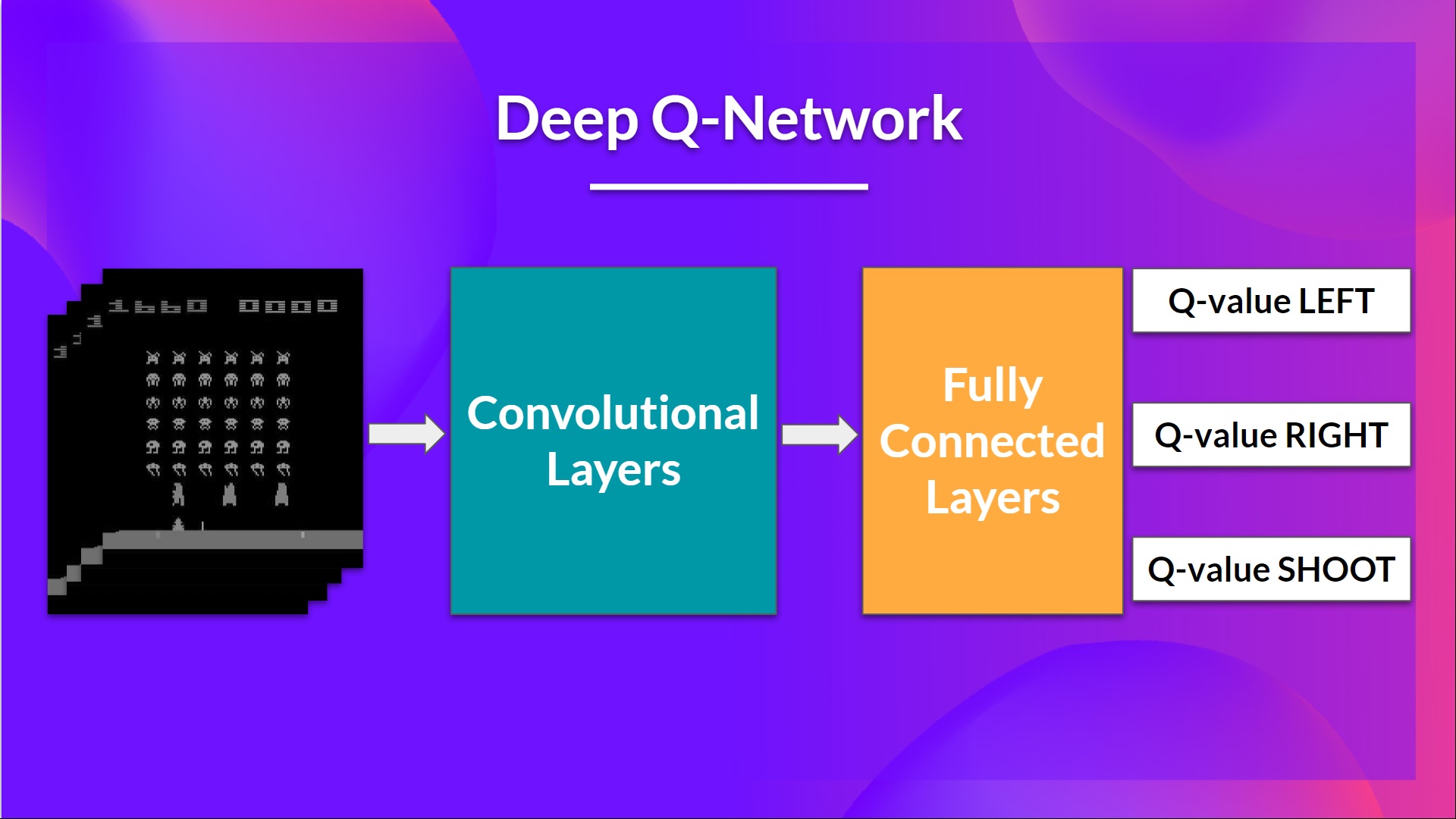 As input, we take a **stack of 4 frames** passed through the network as a state and output a **vector of Q-values for each possible action at that state**. Then, like with Q-Learning, we just need to use our epsilon-greedy policy to select which action to take.
When the Neural Network is initialized, **the Q-value estimation is terrible**. But during training, our Deep Q-Network agent will associate a situation with the appropriate action and **learn to play the game well**.
## Preprocessing the input and temporal limitation [[preprocessing]]
We need to **preprocess the input**. It’s an essential step since we want to **reduce the complexity of our state to reduce the computation time needed for training**.
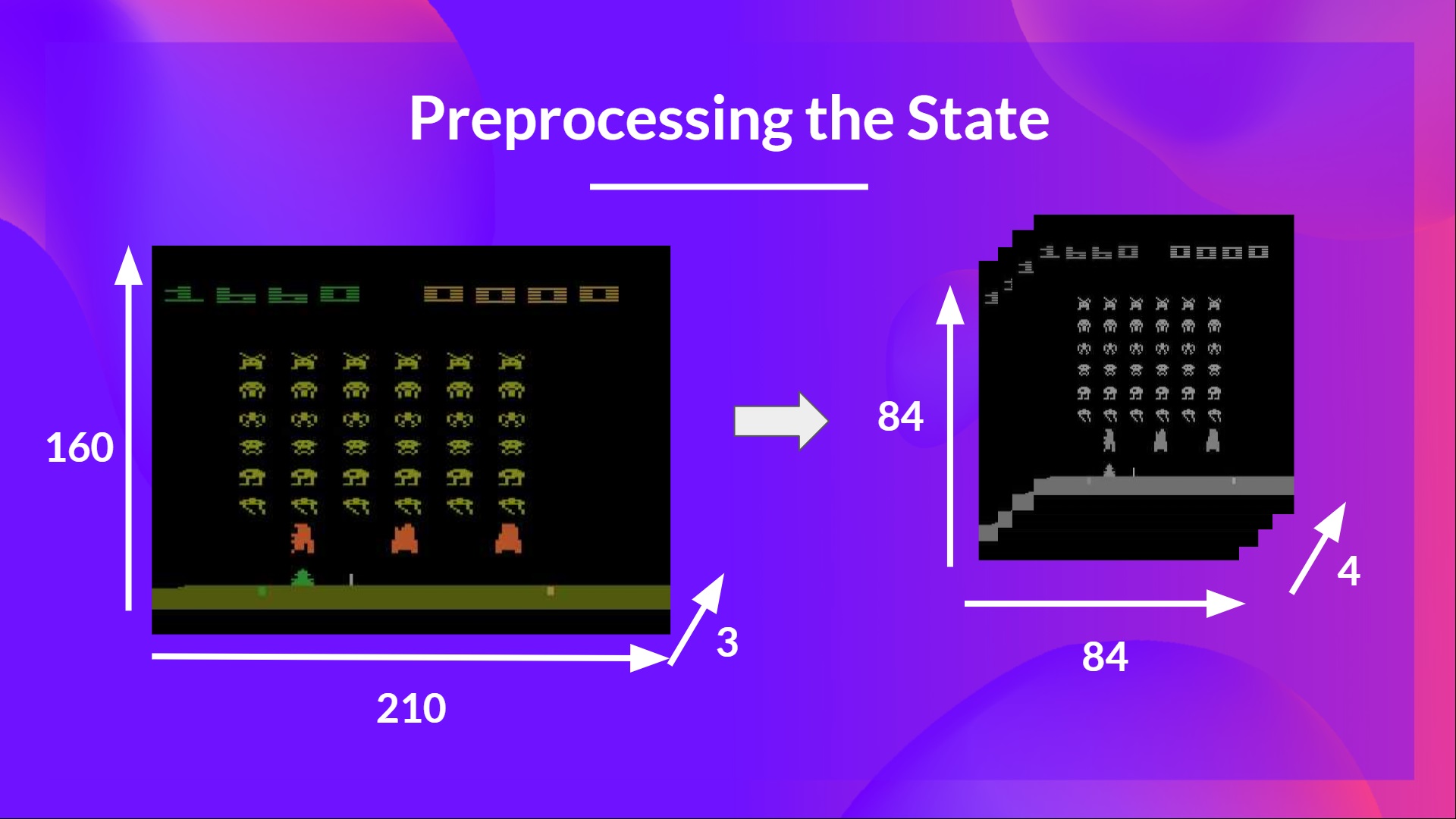
To achieve this, we **reduce the state space to 84x84 and grayscale it**. We can do this since the colors in Atari environments don't add important information.
This is a big improvement since we **reduce our three color channels (RGB) to 1**.
We can also **crop a part of the screen in some games** if it does not contain important information.
Then we stack four frames together.
As input, we take a **stack of 4 frames** passed through the network as a state and output a **vector of Q-values for each possible action at that state**. Then, like with Q-Learning, we just need to use our epsilon-greedy policy to select which action to take.
When the Neural Network is initialized, **the Q-value estimation is terrible**. But during training, our Deep Q-Network agent will associate a situation with the appropriate action and **learn to play the game well**.
## Preprocessing the input and temporal limitation [[preprocessing]]
We need to **preprocess the input**. It’s an essential step since we want to **reduce the complexity of our state to reduce the computation time needed for training**.
To achieve this, we **reduce the state space to 84x84 and grayscale it**. We can do this since the colors in Atari environments don't add important information.
This is a big improvement since we **reduce our three color channels (RGB) to 1**.
We can also **crop a part of the screen in some games** if it does not contain important information.
Then we stack four frames together.
 **Why do we stack four frames together?**
We stack frames together because it helps us **handle the problem of temporal limitation**. Let’s take an example with the game of Pong. When you see this frame:
**Why do we stack four frames together?**
We stack frames together because it helps us **handle the problem of temporal limitation**. Let’s take an example with the game of Pong. When you see this frame:
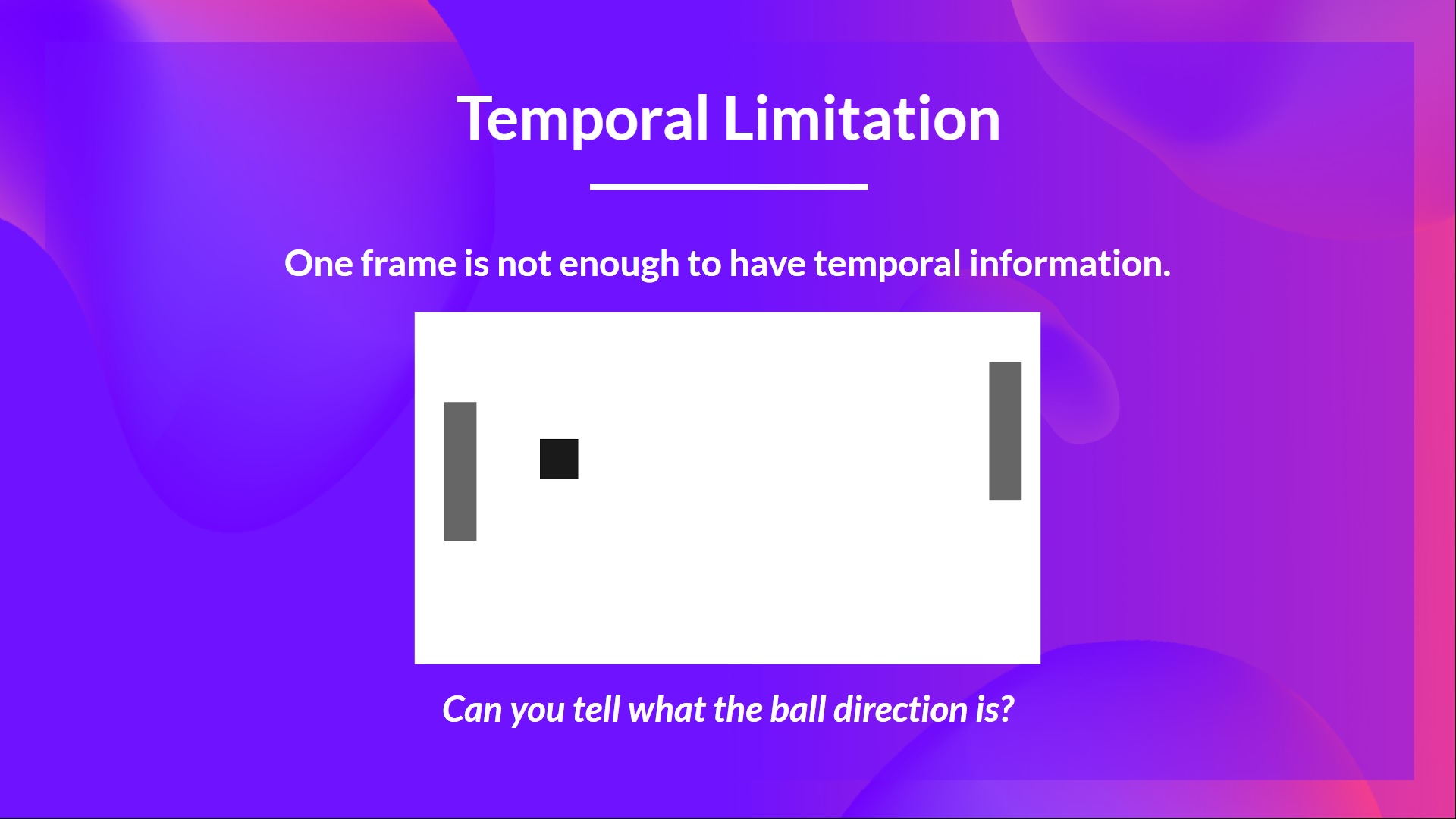 Can you tell me where the ball is going?
No, because one frame is not enough to have a sense of motion! But what if I add three more frames? **Here you can see that the ball is going to the right**.
Can you tell me where the ball is going?
No, because one frame is not enough to have a sense of motion! But what if I add three more frames? **Here you can see that the ball is going to the right**.
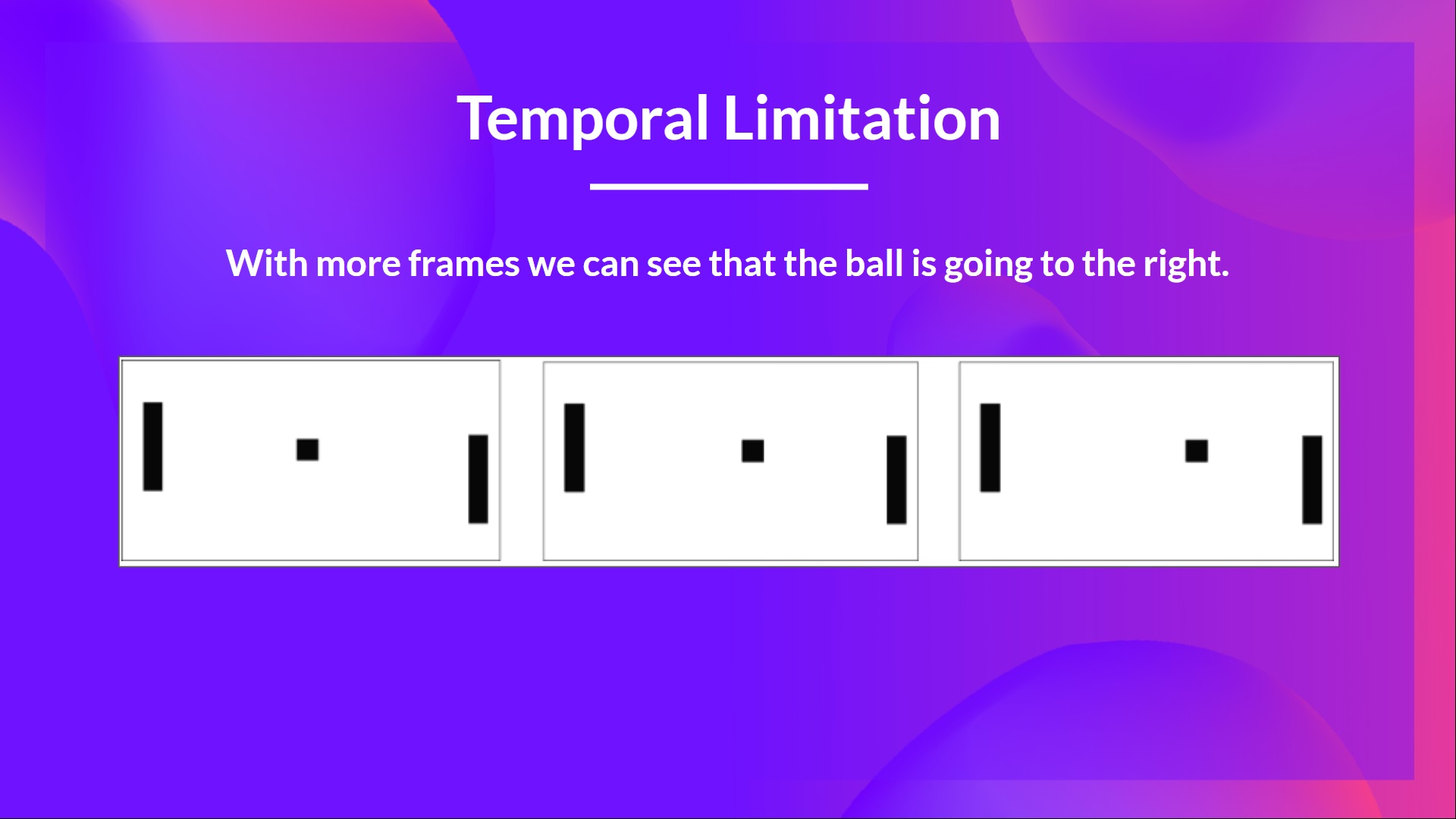 That’s why, to capture temporal information, we stack four frames together.
Then the stacked frames are processed by three convolutional layers. These layers **allow us to capture and exploit spatial relationships in images**. But also, because the frames are stacked together, **we can exploit some temporal properties across those frames**.
If you don't know what convolutional layers are, don't worry. You can check out [Lesson 4 of this free Deep Learning Course by Udacity](https://www.udacity.com/course/deep-learning-pytorch--ud188)
Finally, we have a couple of fully connected layers that output a Q-value for each possible action at that state.
So, we see that Deep Q-Learning uses a neural network to approximate, given a state, the different Q-values for each possible action at that state. Now let's study the Deep Q-Learning algorithm.
That’s why, to capture temporal information, we stack four frames together.
Then the stacked frames are processed by three convolutional layers. These layers **allow us to capture and exploit spatial relationships in images**. But also, because the frames are stacked together, **we can exploit some temporal properties across those frames**.
If you don't know what convolutional layers are, don't worry. You can check out [Lesson 4 of this free Deep Learning Course by Udacity](https://www.udacity.com/course/deep-learning-pytorch--ud188)
Finally, we have a couple of fully connected layers that output a Q-value for each possible action at that state.
So, we see that Deep Q-Learning uses a neural network to approximate, given a state, the different Q-values for each possible action at that state. Now let's study the Deep Q-Learning algorithm.