# Designing Multi-Agents systems
For this section, you're going to watch this excellent introduction to multi-agents made by Brian Douglas .
In this video, Brian talked about how to design multi-agent systems. He specifically took a multi-agents system of vacuum cleaners and asked: **how can can cooperate with each other**?
We have two solutions to design this multi-agent reinforcement learning system (MARL).
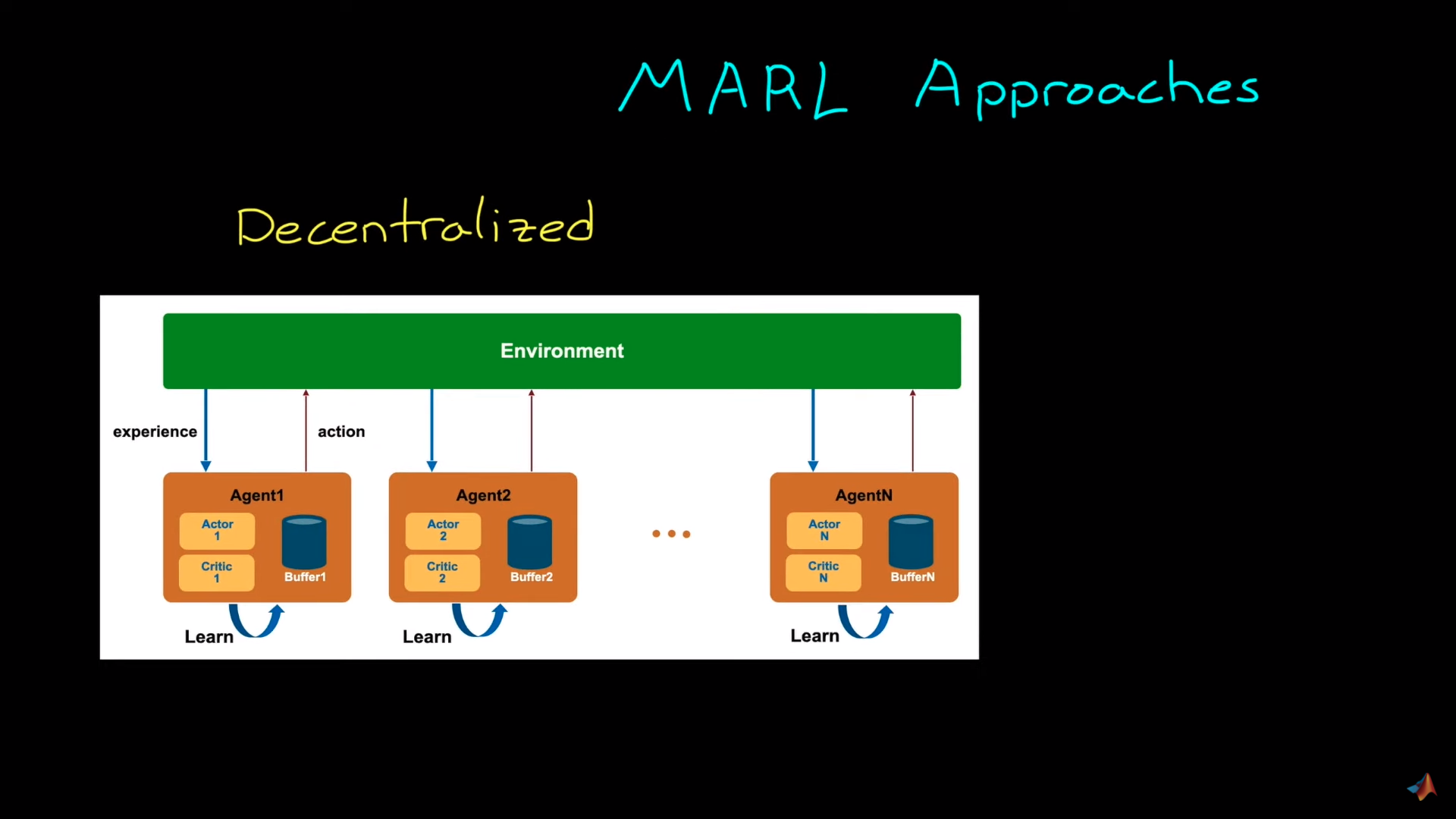
## Decentralized system
Source: Introduction to Multi-Agent Reinforcement Learning
In decentralized learning, **each agent is trained independently from the others**. In the example given, each vacuum learns to clean as many places as it can **without caring about what other vacuums (agents) are doing**.
The benefit is that **since no information is shared between agents, these vacuums can be designed and trained like we train single agents**.
The idea here is that **our training agent will consider other agents as part of the environment dynamics**. Not as agents.
However, the big drawback of this technique is that it will **make the environment non-stationary** since the underlying Markov decision process changes over time as other agents are also interacting in the environment.
And this is problematic for many Reinforcement Learning algorithms **that can't reach a global optimum with a non-stationary environment**.
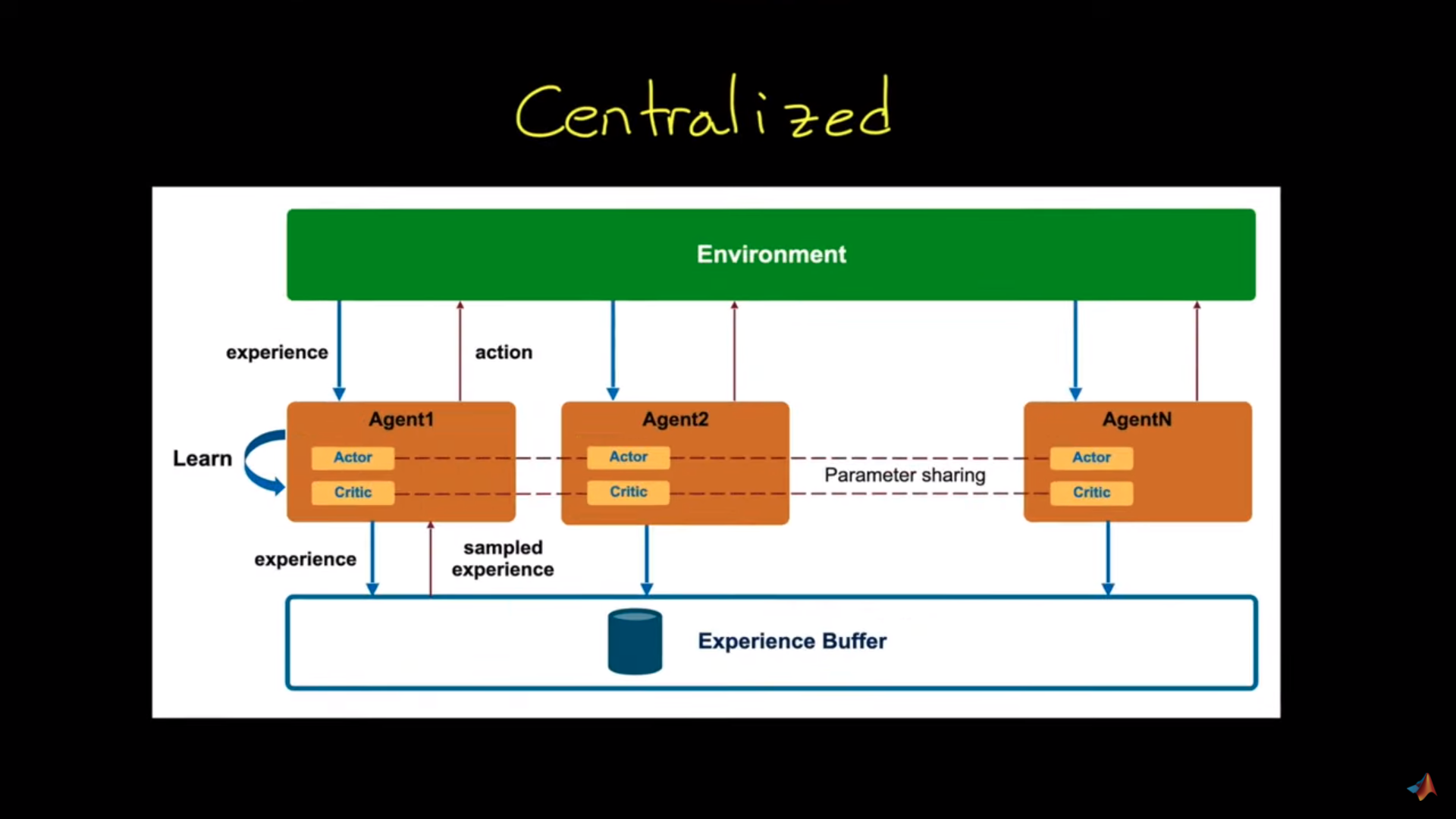
## Centralized approach
Source: Introduction to Multi-Agent Reinforcement Learning
In this architecture, **we have a high-level process that collects agents' experiences**: the experience buffer. And we'll use these experiences **to learn a common policy**.
For instance, in the vacuum cleaner example, the observation will be:
- The coverage map of the vacuums.
- The position of all the vacuums.
We use that collective experience **to train a policy that will move all three robots in the most beneficial way as a whole**. So each robot is learning from their common experience.
We now have a stationary environment since all the agents are treated as a larger entity, and they know the change of other agents' policies (since it's the same as theirs).
If we recap:
- In a *decentralized approach*, we **treat all agents independently without considering the existence of the other agents.**
- In this case, all agents **consider others agents as part of the environment**.
- **It’s a non-stationarity environment condition**, so has no guarantee of convergence.
- In a *centralized approach*:
- A **single policy is learned from all the agents**.
- Takes as input the present state of an environment and the policy outputs joint actions.
- The reward is global.