# The Problem of Variance in Reinforce [[the-problem-of-variance-in-reinforce]]
In Reinforce, we want to **increase the probability of actions in a trajectory proportional to how high the return is**.
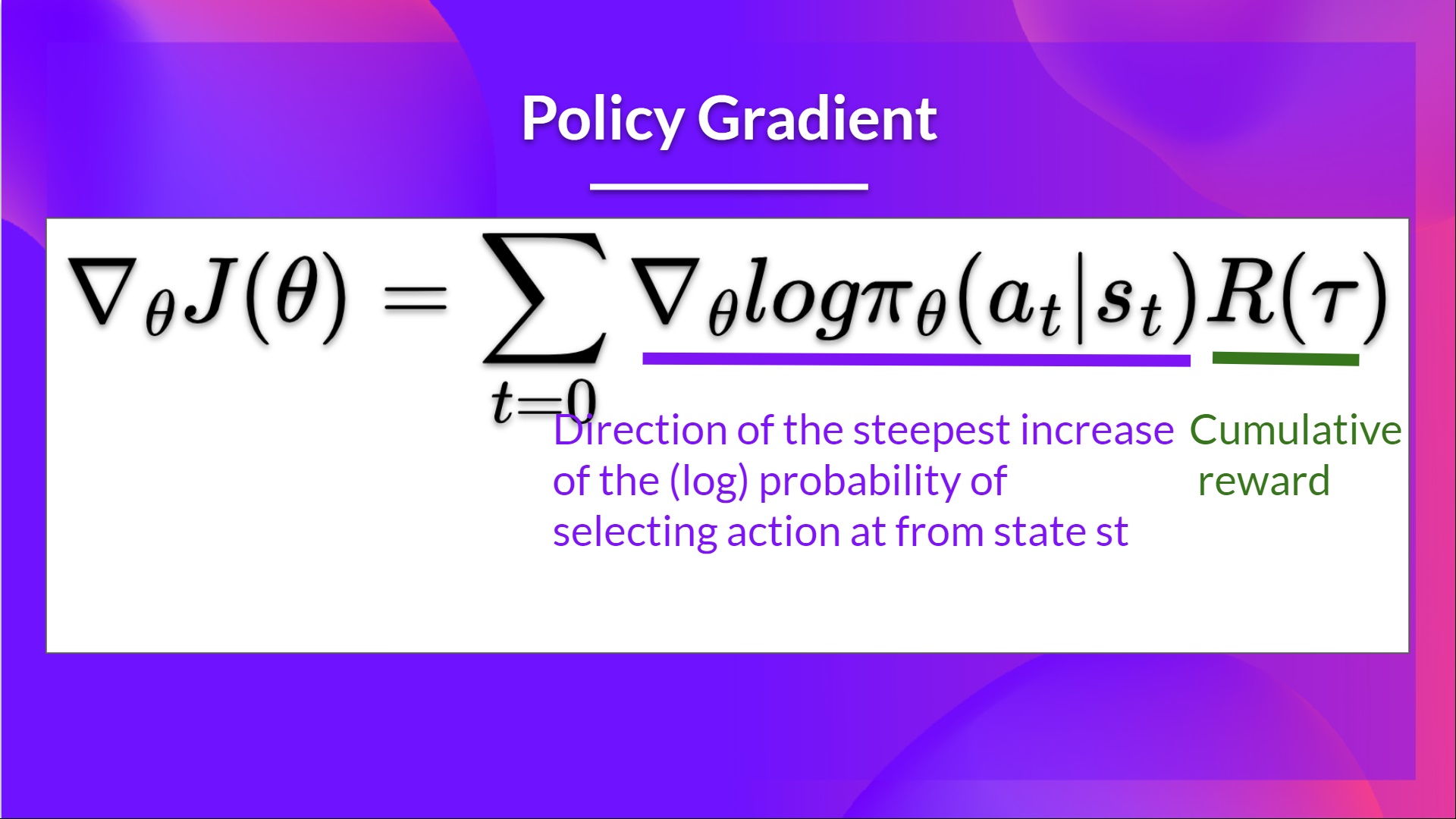 - If the **return is high**, we will **push up** the probabilities of the (state, action) combinations.
- Else, if the **return is low**, it will **push down** the probabilities of the (state, action) combinations.
This return \\(R(\tau)\\) is calculated using a *Monte-Carlo sampling*. We collect a trajectory and calculate the discounted return, **and use this score to increase or decrease the probability of every action taken in that trajectory**. If the return is good, all actions will be “reinforced” by increasing their likelihood of being taken.
\\(R(\tau) = R_{t+1} + \gamma R_{t+2} + \gamma^2 R_{t+3} + ...\\)
The advantage of this method is that **it’s unbiased. Since we’re not estimating the return**, we use only the true return we obtain.
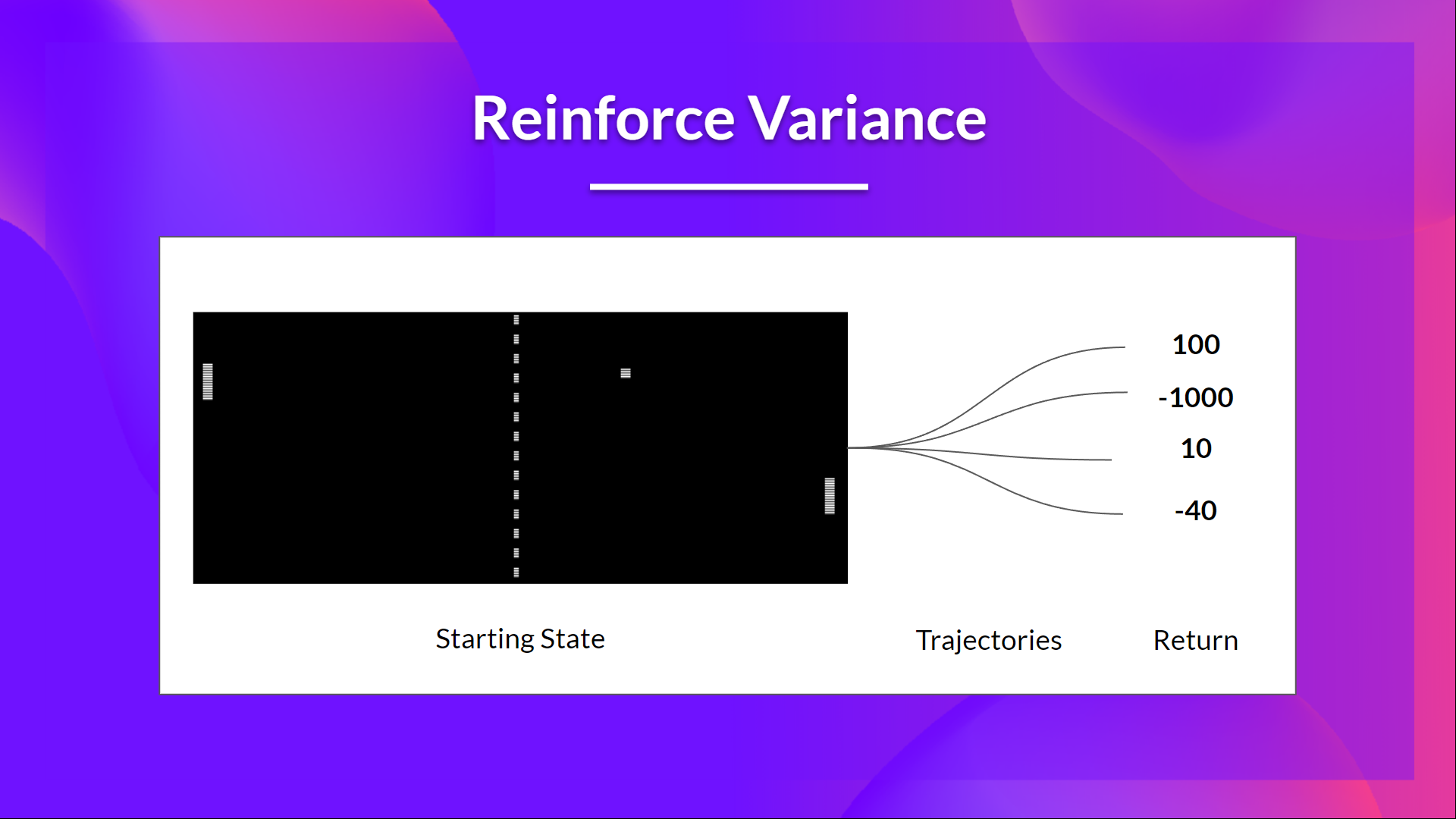
Given the stochasticity of the environment (random events during an episode) and stochasticity of the policy, **trajectories can lead to different returns, which can lead to high variance**. Consequently, the same starting state can lead to very different returns.
Because of this, **the return starting at the same state can vary significantly across episodes**.
- If the **return is high**, we will **push up** the probabilities of the (state, action) combinations.
- Else, if the **return is low**, it will **push down** the probabilities of the (state, action) combinations.
This return \\(R(\tau)\\) is calculated using a *Monte-Carlo sampling*. We collect a trajectory and calculate the discounted return, **and use this score to increase or decrease the probability of every action taken in that trajectory**. If the return is good, all actions will be “reinforced” by increasing their likelihood of being taken.
\\(R(\tau) = R_{t+1} + \gamma R_{t+2} + \gamma^2 R_{t+3} + ...\\)
The advantage of this method is that **it’s unbiased. Since we’re not estimating the return**, we use only the true return we obtain.
Given the stochasticity of the environment (random events during an episode) and stochasticity of the policy, **trajectories can lead to different returns, which can lead to high variance**. Consequently, the same starting state can lead to very different returns.
Because of this, **the return starting at the same state can vary significantly across episodes**.
 The solution is to mitigate the variance by **using a large number of trajectories, hoping that the variance introduced in any one trajectory will be reduced in aggregate and provide a "true" estimation of the return.**
However, increasing the batch size significantly **reduces sample efficiency**. So we need to find additional mechanisms to reduce the variance.
---
If you want to dive deeper into the question of variance and bias tradeoff in Deep Reinforcement Learning, you can check these two articles:
- [Making Sense of the Bias / Variance Trade-off in (Deep) Reinforcement Learning](https://blog.mlreview.com/making-sense-of-the-bias-variance-trade-off-in-deep-reinforcement-learning-79cf1e83d565)
- [Bias-variance Tradeoff in Reinforcement Learning](https://www.endtoend.ai/blog/bias-variance-tradeoff-in-reinforcement-learning/)
---
The solution is to mitigate the variance by **using a large number of trajectories, hoping that the variance introduced in any one trajectory will be reduced in aggregate and provide a "true" estimation of the return.**
However, increasing the batch size significantly **reduces sample efficiency**. So we need to find additional mechanisms to reduce the variance.
---
If you want to dive deeper into the question of variance and bias tradeoff in Deep Reinforcement Learning, you can check these two articles:
- [Making Sense of the Bias / Variance Trade-off in (Deep) Reinforcement Learning](https://blog.mlreview.com/making-sense-of-the-bias-variance-trade-off-in-deep-reinforcement-learning-79cf1e83d565)
- [Bias-variance Tradeoff in Reinforcement Learning](https://www.endtoend.ai/blog/bias-variance-tradeoff-in-reinforcement-learning/)
---