# A Q-Learning example [[q-learning-example]]
To better understand Q-Learning, let's take a simple example:
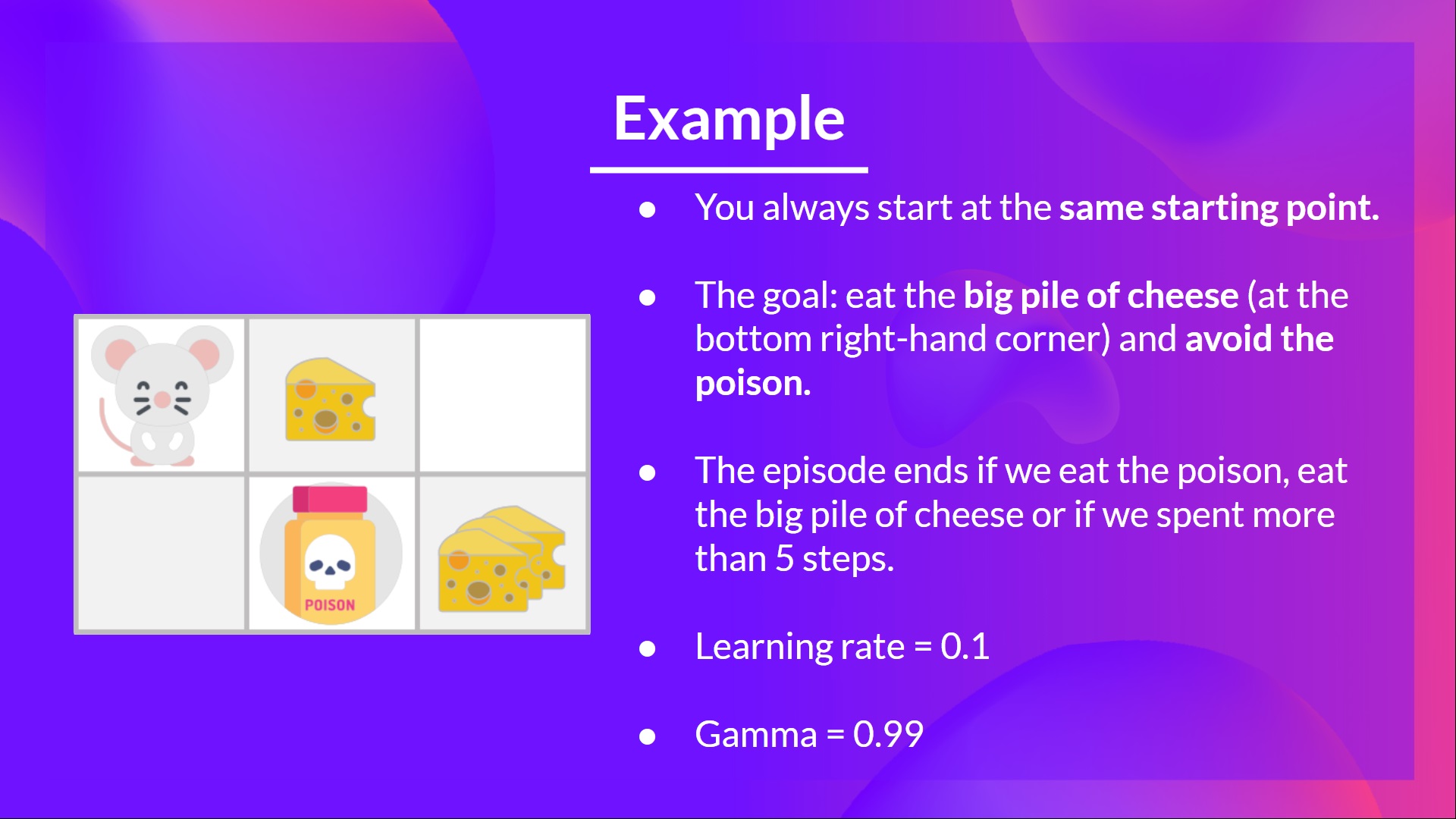
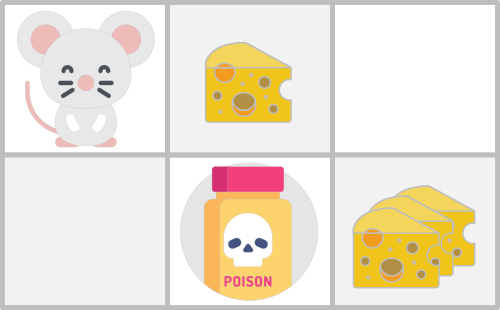 - You're a mouse in this tiny maze. You always **start at the same starting point.**
- The goal is **to eat the big pile of cheese at the bottom right-hand corner** and avoid the poison. After all, who doesn't like cheese?
- The episode ends if we eat the poison, **eat the big pile of cheese or if we spent more than five steps.**
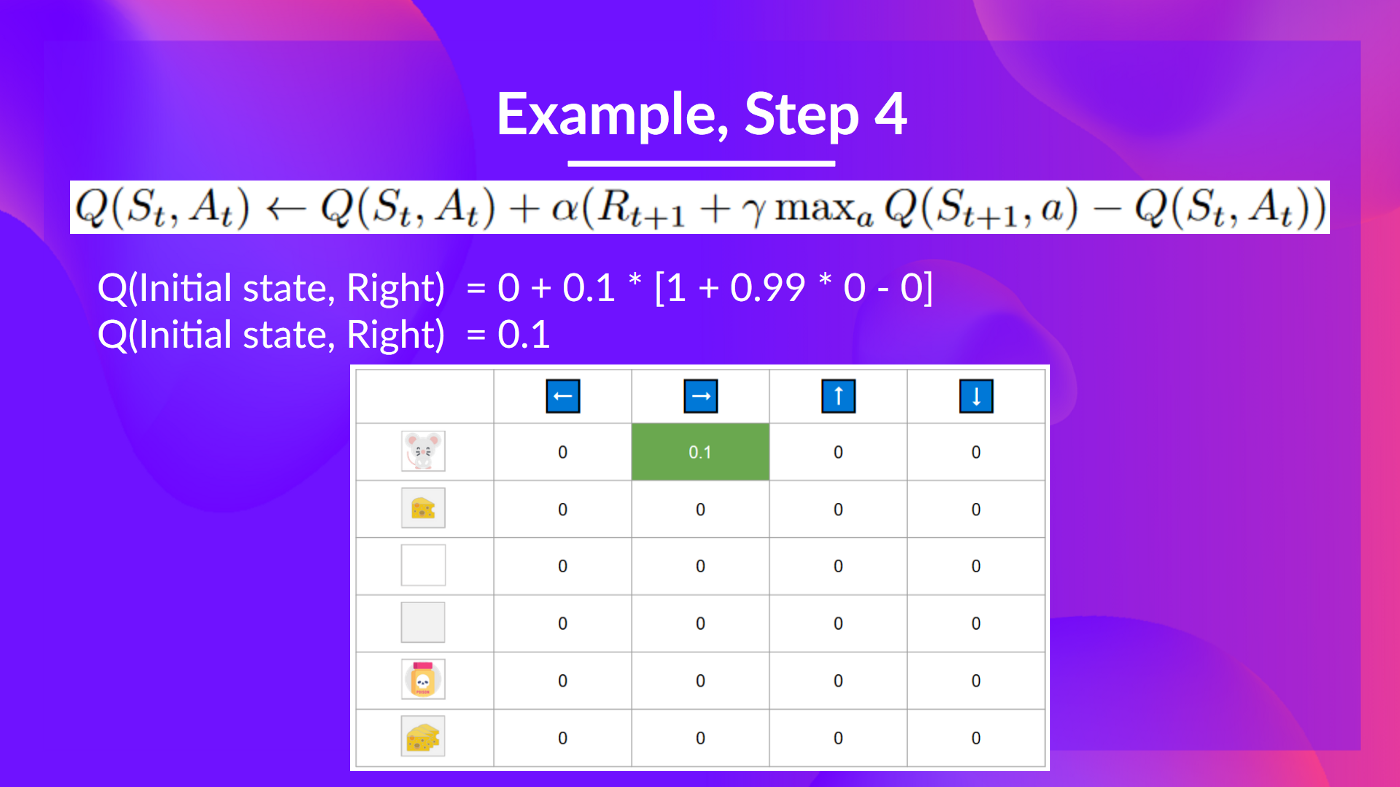
- The learning rate is 0.1
- The gamma (discount rate) is 0.99
- You're a mouse in this tiny maze. You always **start at the same starting point.**
- The goal is **to eat the big pile of cheese at the bottom right-hand corner** and avoid the poison. After all, who doesn't like cheese?
- The episode ends if we eat the poison, **eat the big pile of cheese or if we spent more than five steps.**
- The learning rate is 0.1
- The gamma (discount rate) is 0.99
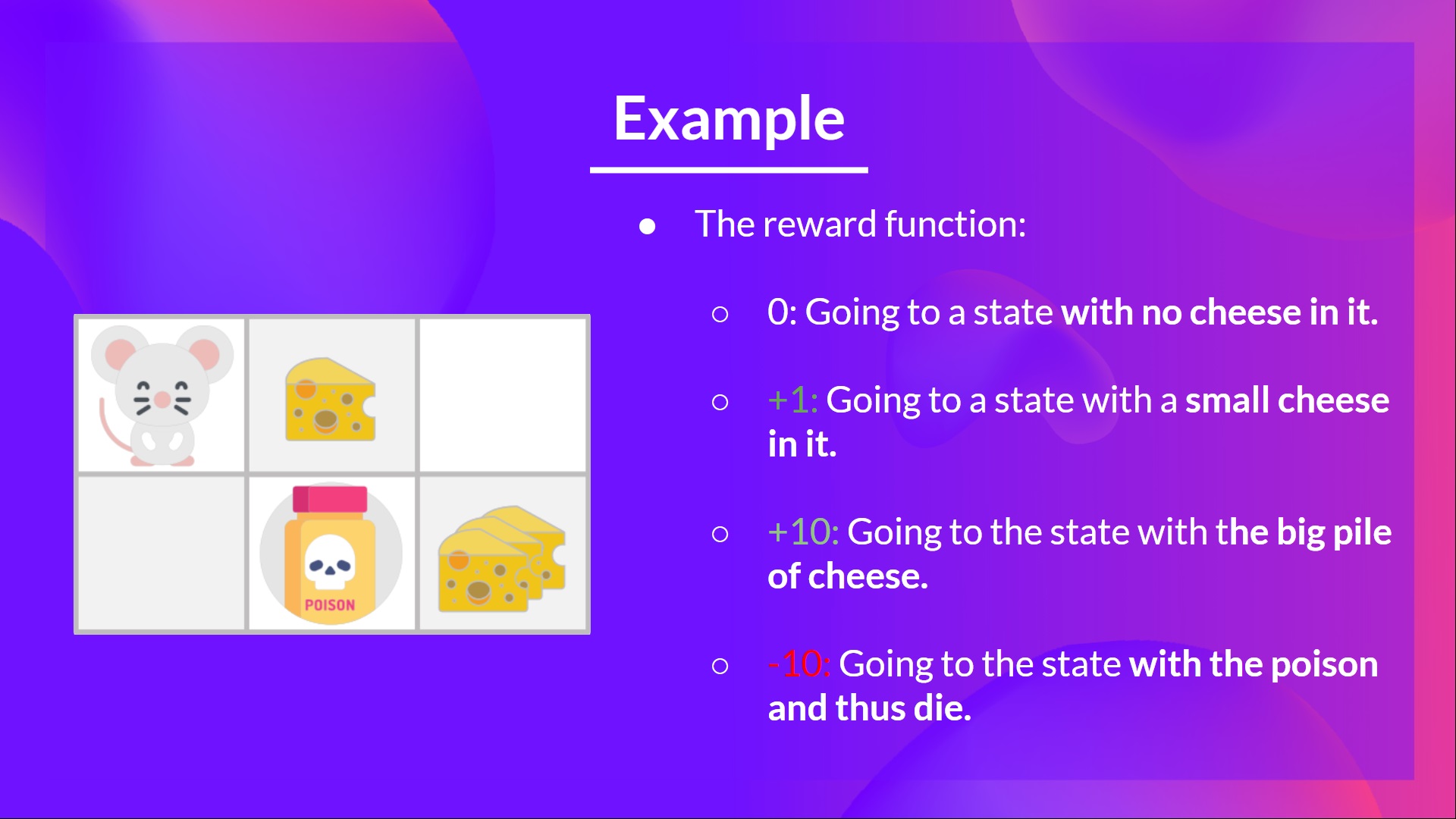
 The reward function goes like this:
- **+0:** Going to a state with no cheese in it.
- **+1:** Going to a state with a small cheese in it.
- **+10:** Going to the state with the big pile of cheese.
- **-10:** Going to the state with the poison and thus die.
- **+0** If we spend more than five steps.
The reward function goes like this:
- **+0:** Going to a state with no cheese in it.
- **+1:** Going to a state with a small cheese in it.
- **+10:** Going to the state with the big pile of cheese.
- **-10:** Going to the state with the poison and thus die.
- **+0** If we spend more than five steps.
 To train our agent to have an optimal policy (so a policy that goes right, right, down), **we will use the Q-Learning algorithm**.
## Step 1: We initialize the Q-table [[step1]]
To train our agent to have an optimal policy (so a policy that goes right, right, down), **we will use the Q-Learning algorithm**.
## Step 1: We initialize the Q-table [[step1]]
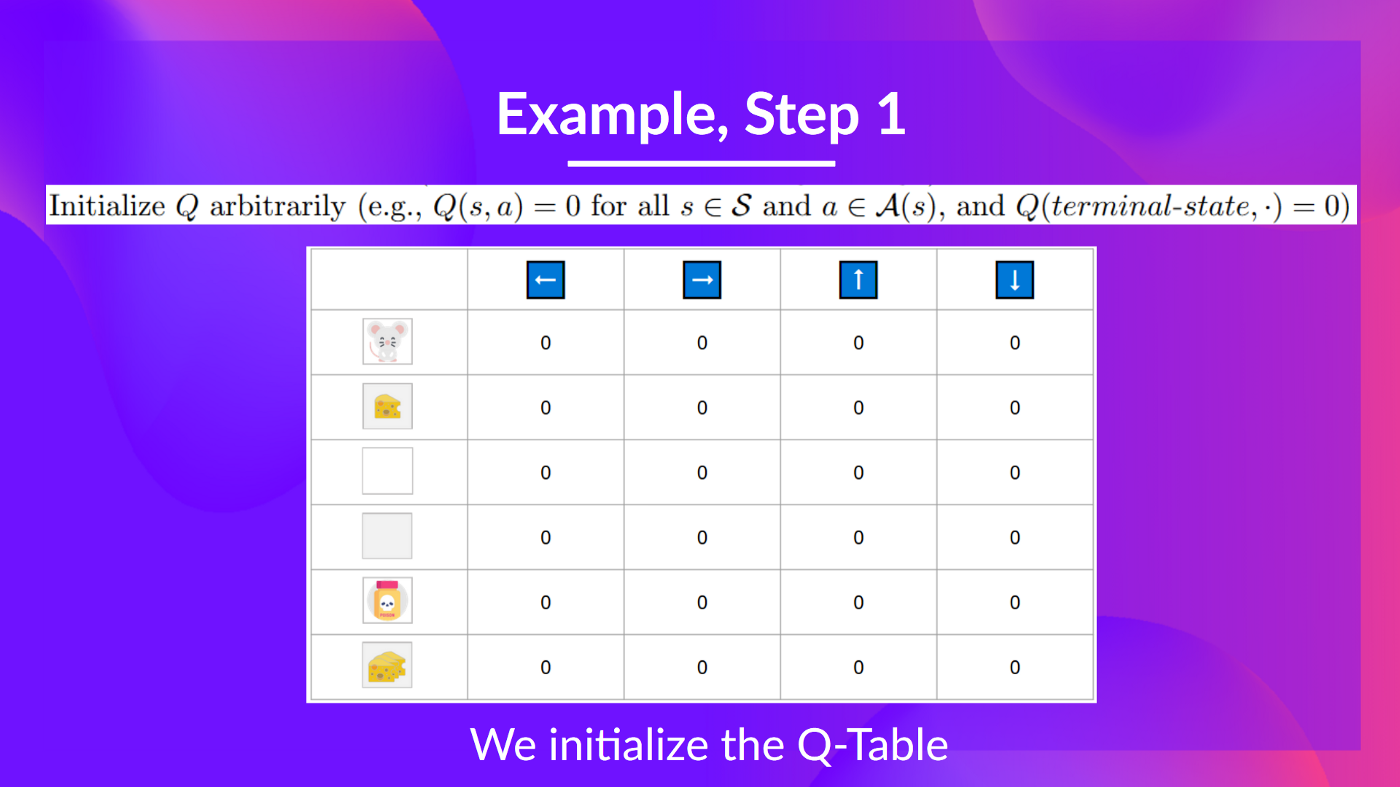 So, for now, **our Q-table is useless**; we need **to train our Q-function using the Q-Learning algorithm.**
Let's do it for 2 training timesteps:
Training timestep 1:
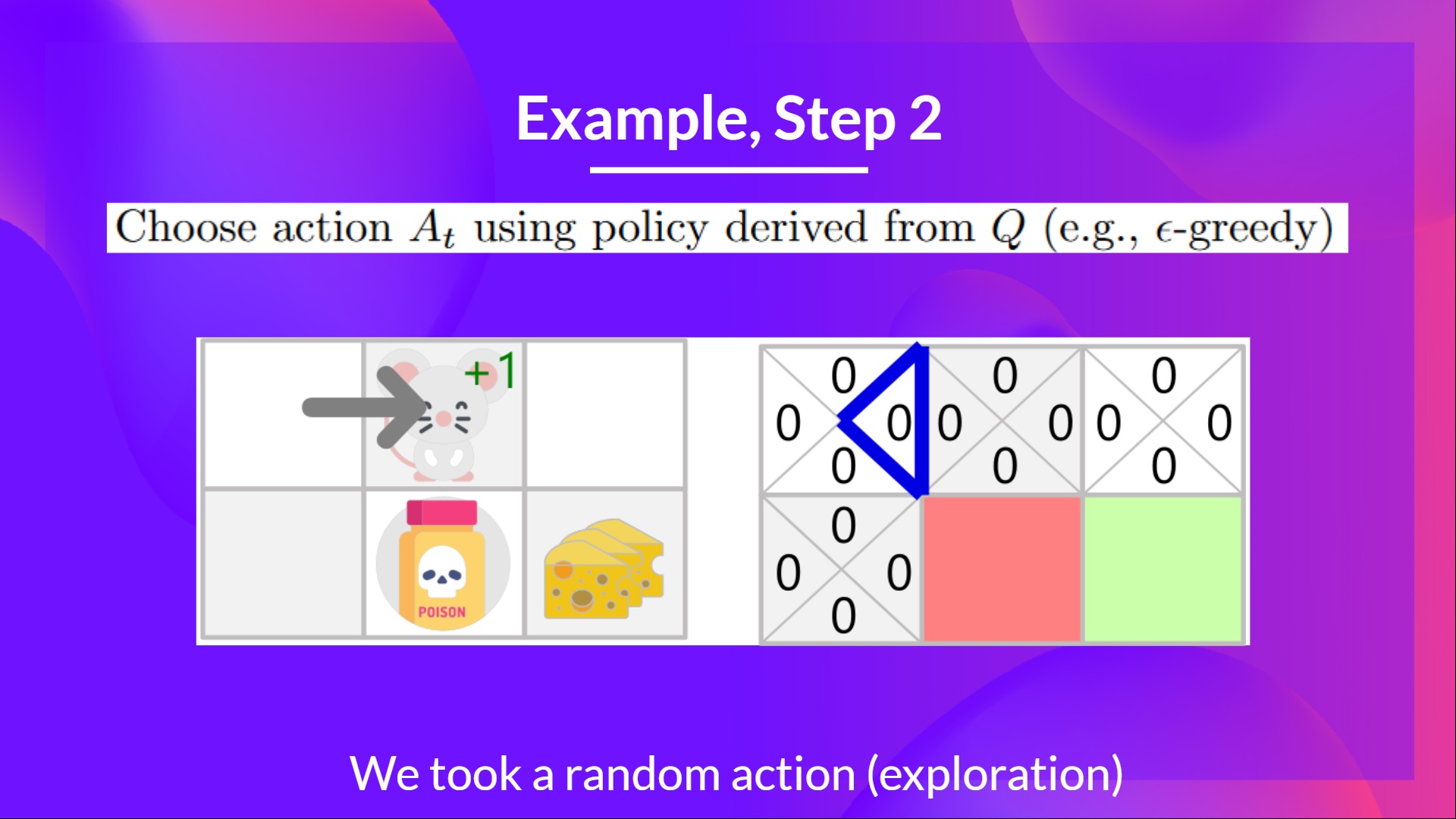
## Step 2: Choose action using Epsilon Greedy Strategy [[step2]]
Because epsilon is big = 1.0, I take a random action, in this case, I go right.
So, for now, **our Q-table is useless**; we need **to train our Q-function using the Q-Learning algorithm.**
Let's do it for 2 training timesteps:
Training timestep 1:
## Step 2: Choose action using Epsilon Greedy Strategy [[step2]]
Because epsilon is big = 1.0, I take a random action, in this case, I go right.
 ## Step 3: Perform action At, gets Rt+1 and St+1 [[step3]]
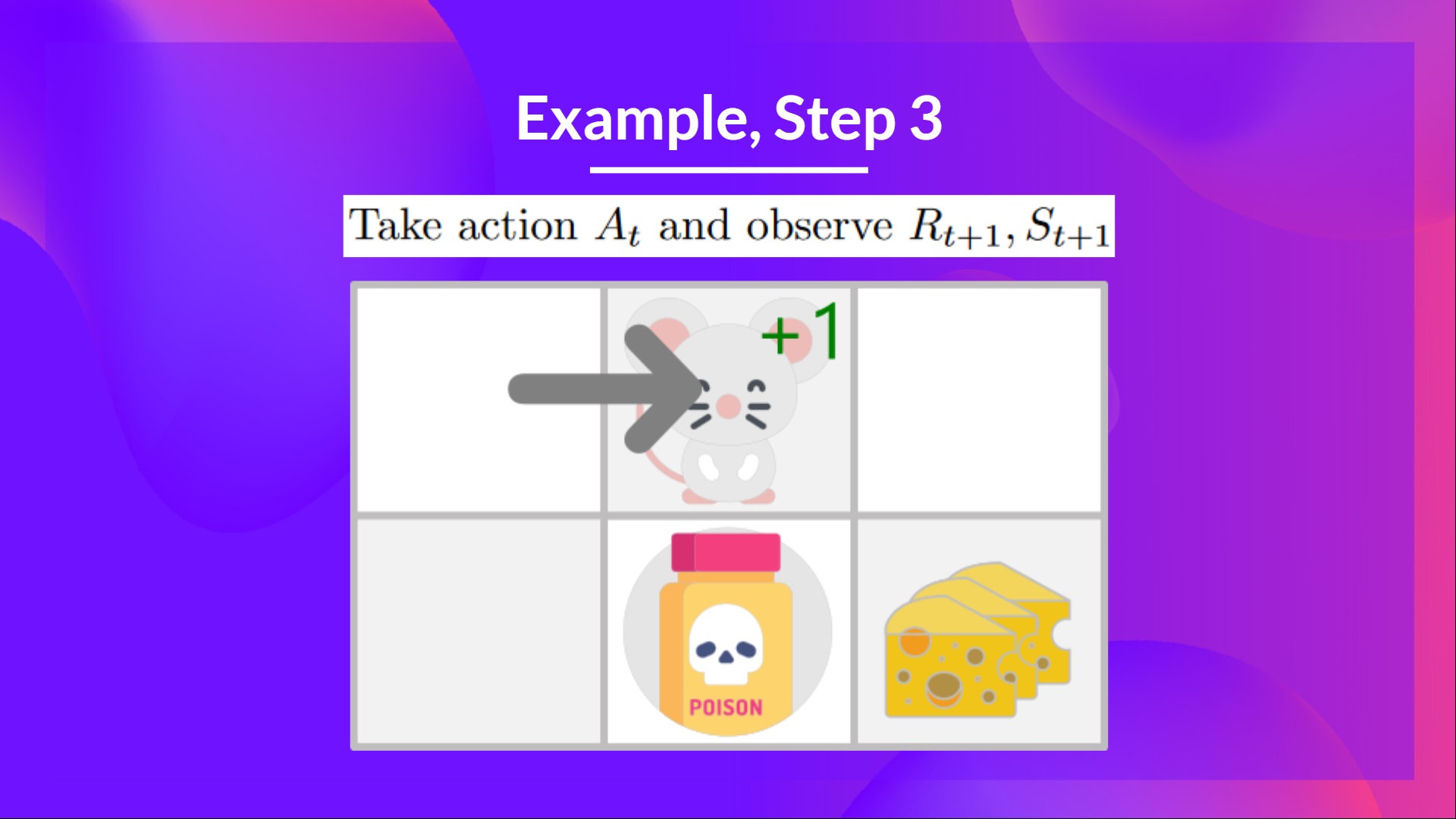
By going right, I've got a small cheese, so \\(R_{t+1} = 1\\), and I'm in a new state.
## Step 3: Perform action At, gets Rt+1 and St+1 [[step3]]
By going right, I've got a small cheese, so \\(R_{t+1} = 1\\), and I'm in a new state.
 ## Step 4: Update Q(St, At) [[step4]]
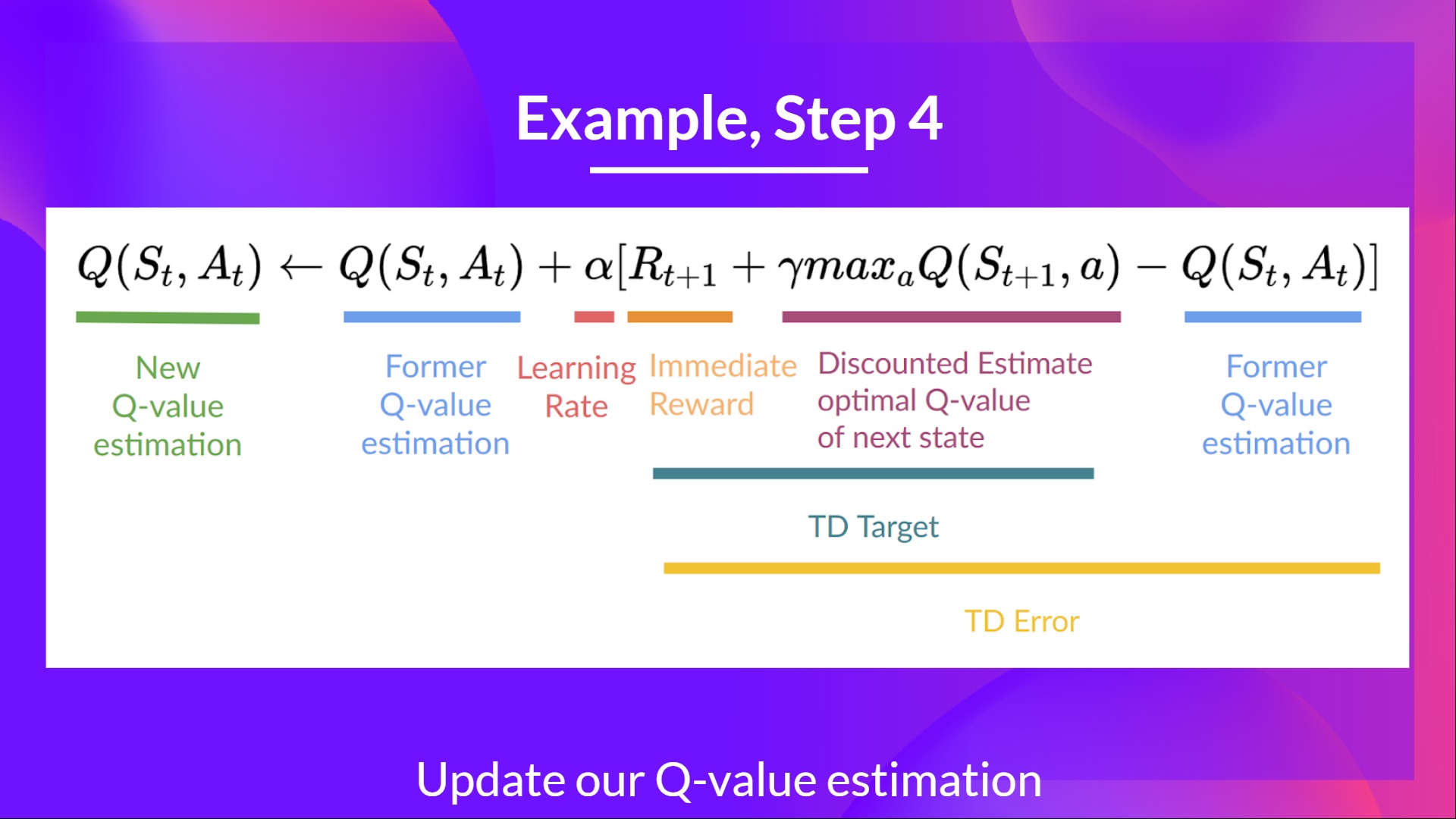
We can now update \\(Q(S_t, A_t)\\) using our formula.
## Step 4: Update Q(St, At) [[step4]]
We can now update \\(Q(S_t, A_t)\\) using our formula.
 Training timestep 2:
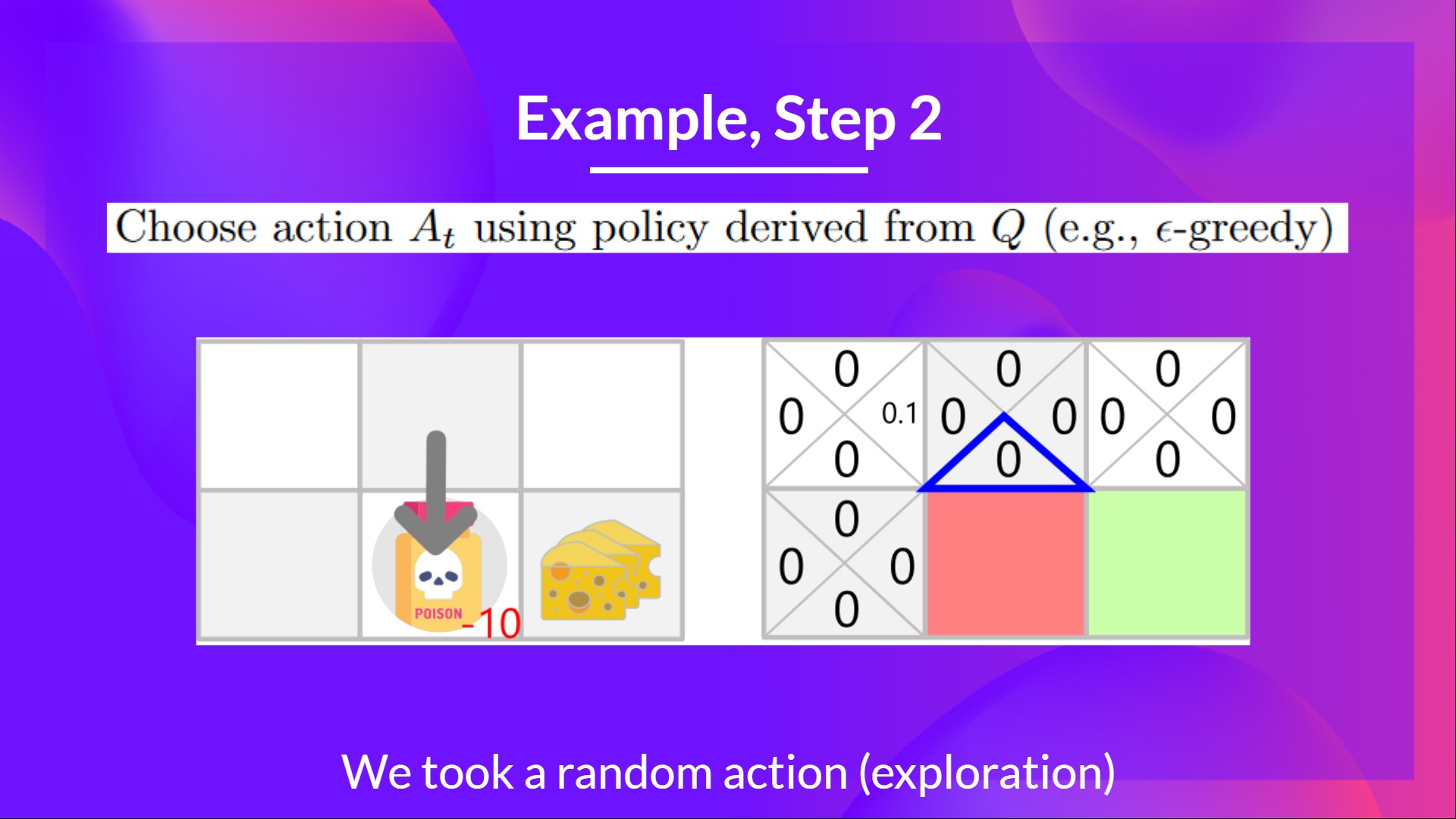
## Step 2: Choose action using Epsilon Greedy Strategy [[step2-2]]
**I take a random action again, since epsilon is big 0.99** (since we decay it a little bit because as the training progress, we want less and less exploration).
I took action down. **Not a good action since it leads me to the poison.**
Training timestep 2:
## Step 2: Choose action using Epsilon Greedy Strategy [[step2-2]]
**I take a random action again, since epsilon is big 0.99** (since we decay it a little bit because as the training progress, we want less and less exploration).
I took action down. **Not a good action since it leads me to the poison.**
 ## Step 3: Perform action At, gets Rt+1 and St+1 [[step3-3]]
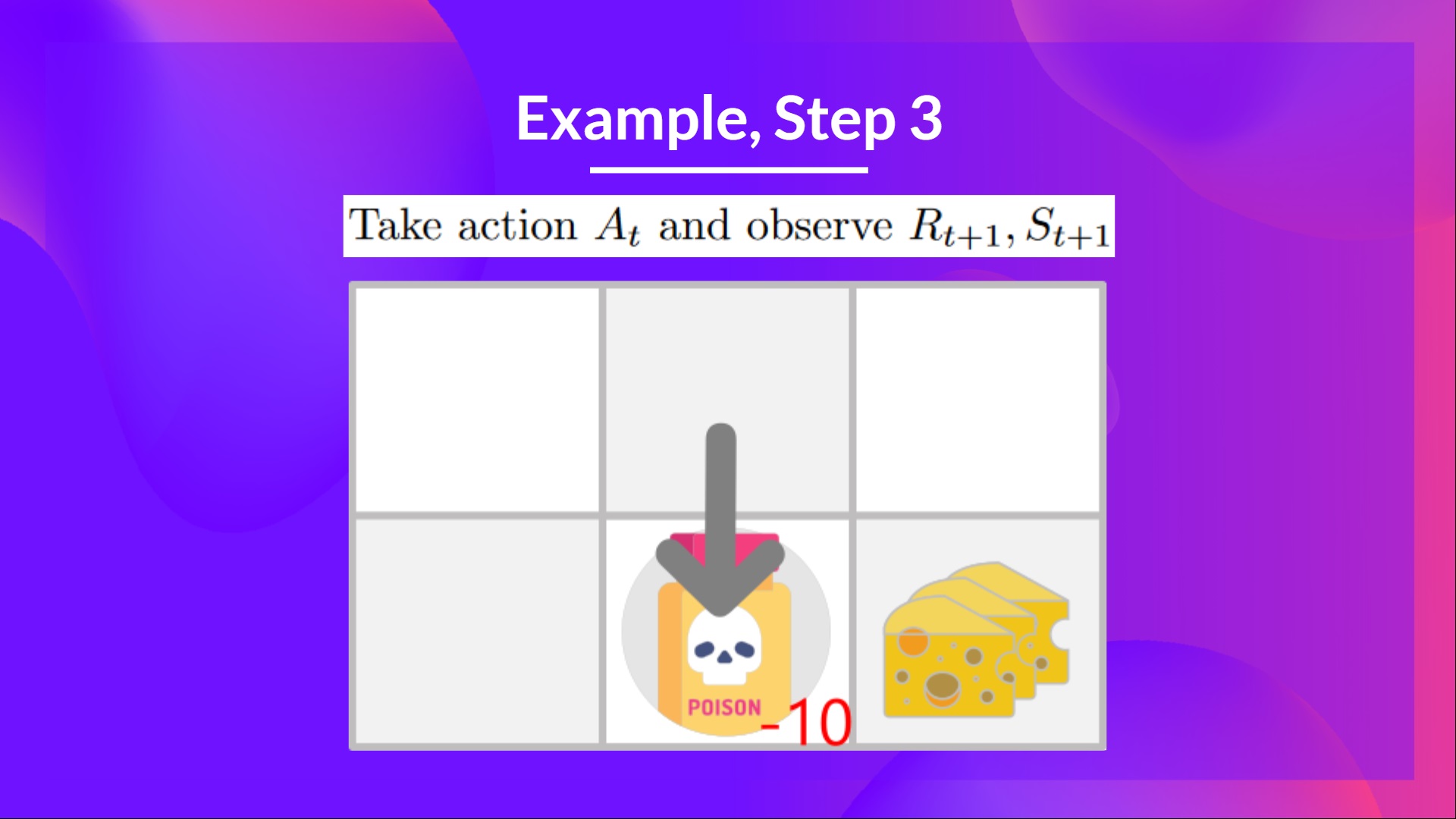
Because I go to the poison state, **I get \\(R_{t+1} = -10\\), and I die.**
## Step 3: Perform action At, gets Rt+1 and St+1 [[step3-3]]
Because I go to the poison state, **I get \\(R_{t+1} = -10\\), and I die.**
 ## Step 4: Update Q(St, At) [[step4-4]]
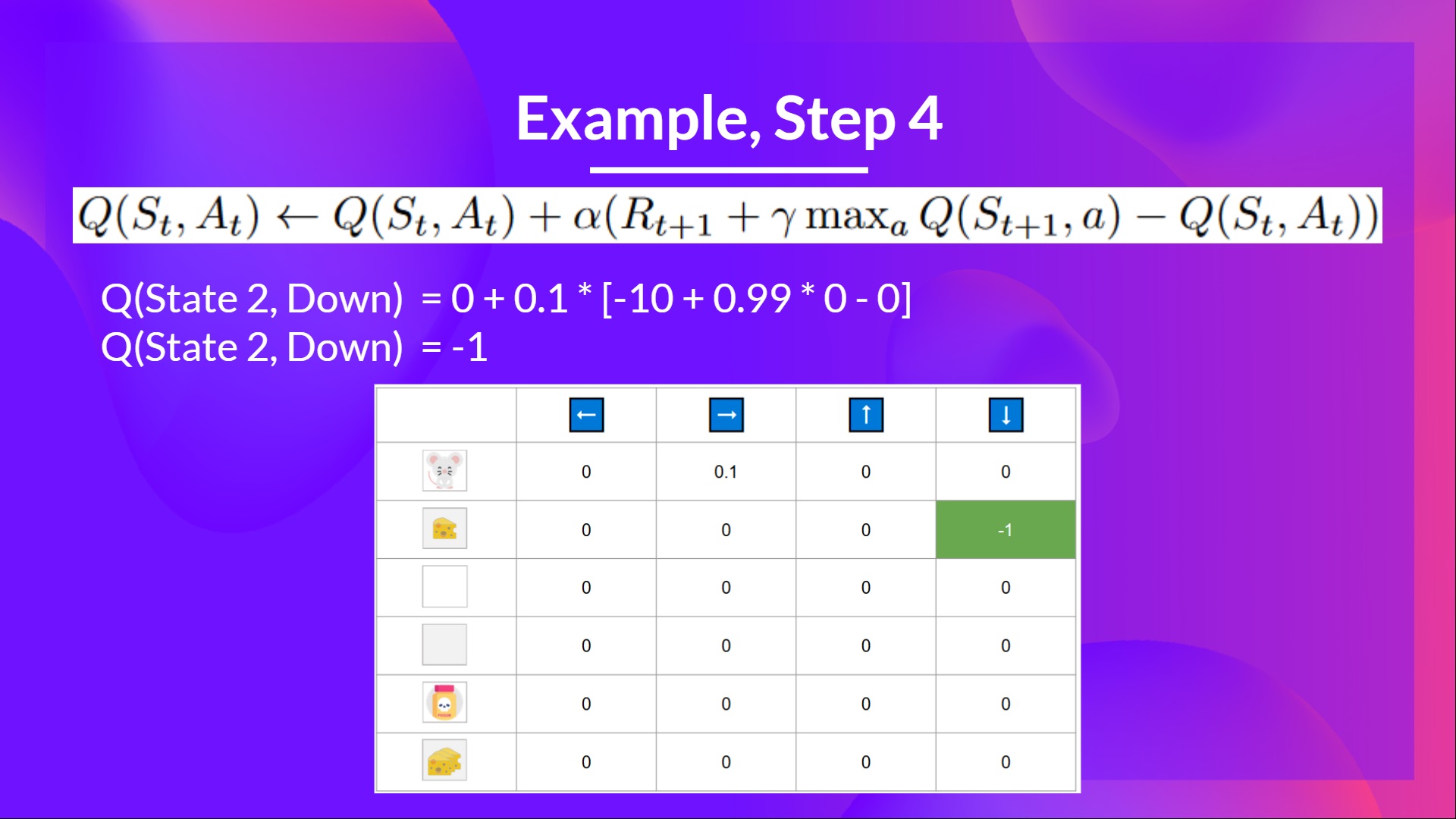 Because we're dead, we start a new episode. But what we see here is that **with two explorations steps, my agent became smarter.**
As we continue exploring and exploiting the environment and updating Q-values using TD target, **Q-table will give us better and better approximations. And thus, at the end of the training, we'll get an estimate of the optimal Q-function.**
Because we're dead, we start a new episode. But what we see here is that **with two explorations steps, my agent became smarter.**
As we continue exploring and exploiting the environment and updating Q-values using TD target, **Q-table will give us better and better approximations. And thus, at the end of the training, we'll get an estimate of the optimal Q-function.**