mirror of
https://github.com/youngyangyang04/leetcode-master.git
synced 2026-02-02 18:39:09 +08:00

628 lines
17 KiB
Markdown
Executable File
628 lines
17 KiB
Markdown
Executable File
* [做项目(多个C++、Java、Go、测开、前端项目)](https://www.programmercarl.com/other/kstar.html)
|
||
* [刷算法(两个月高强度学算法)](https://www.programmercarl.com/xunlian/xunlianying.html)
|
||
* [背八股(40天挑战高频面试题)](https://www.programmercarl.com/xunlian/bagu.html)
|
||
|
||
# 121. 买卖股票的最佳时机
|
||
|
||
[力扣题目链接](https://leetcode.cn/problems/best-time-to-buy-and-sell-stock/)
|
||
|
||
给定一个数组 prices ,它的第 i 个元素 prices[i] 表示一支给定股票第 i 天的价格。
|
||
|
||
你只能选择 某一天 买入这只股票,并选择在 未来的某一个不同的日子 卖出该股票。设计一个算法来计算你所能获取的最大利润。
|
||
|
||
返回你可以从这笔交易中获取的最大利润。如果你不能获取任何利润,返回 0 。
|
||
|
||
* 示例 1:
|
||
* 输入:[7,1,5,3,6,4]
|
||
* 输出:5
|
||
解释:在第 2 天(股票价格 = 1)的时候买入,在第 5 天(股票价格 = 6)的时候卖出,最大利润 = 6-1 = 5 。注意利润不能是 7-1 = 6, 因为卖出价格需要大于买入价格;同时,你不能在买入前卖出股票。
|
||
|
||
* 示例 2:
|
||
* 输入:prices = [7,6,4,3,1]
|
||
* 输出:0
|
||
解释:在这种情况下, 没有交易完成, 所以最大利润为 0。
|
||
|
||
## 算法公开课
|
||
|
||
**[《代码随想录》算法视频公开课](https://programmercarl.com/other/gongkaike.html):[动态规划之 LeetCode:121.买卖股票的最佳时机1](https://www.bilibili.com/video/BV1Xe4y1u77q),相信结合视频再看本篇题解,更有助于大家对本题的理解**。
|
||
|
||
## 思路
|
||
|
||
### 暴力
|
||
|
||
这道题目最直观的想法,就是暴力,找最优间距了。
|
||
|
||
```CPP
|
||
class Solution {
|
||
public:
|
||
int maxProfit(vector<int>& prices) {
|
||
int result = 0;
|
||
for (int i = 0; i < prices.size(); i++) {
|
||
for (int j = i + 1; j < prices.size(); j++){
|
||
result = max(result, prices[j] - prices[i]);
|
||
}
|
||
}
|
||
return result;
|
||
}
|
||
};
|
||
```
|
||
|
||
* 时间复杂度:O(n^2)
|
||
* 空间复杂度:O(1)
|
||
|
||
当然该方法超时了。
|
||
|
||
### 贪心
|
||
|
||
因为股票就买卖一次,那么贪心的想法很自然就是取最左最小值,取最右最大值,那么得到的差值就是最大利润。
|
||
|
||
C++代码如下:
|
||
|
||
```CPP
|
||
class Solution {
|
||
public:
|
||
int maxProfit(vector<int>& prices) {
|
||
int low = INT_MAX;
|
||
int result = 0;
|
||
for (int i = 0; i < prices.size(); i++) {
|
||
low = min(low, prices[i]); // 取最左最小价格
|
||
result = max(result, prices[i] - low); // 直接取最大区间利润
|
||
}
|
||
return result;
|
||
}
|
||
};
|
||
```
|
||
|
||
* 时间复杂度:O(n)
|
||
* 空间复杂度:O(1)
|
||
|
||
### 动态规划
|
||
|
||
动规五部曲分析如下:
|
||
|
||
1. 确定dp数组(dp table)以及下标的含义
|
||
|
||
dp[i][0] 表示第i天持有股票所得最多现金 ,**这里可能有同学疑惑,本题中只能买卖一次,持有股票之后哪还有现金呢?**
|
||
|
||
其实一开始现金是0,那么加入第i天买入股票现金就是 -prices[i], 这是一个负数。
|
||
|
||
dp[i][1] 表示第i天不持有股票所得最多现金
|
||
|
||
**注意这里说的是“持有”,“持有”不代表就是当天“买入”!也有可能是昨天就买入了,今天保持持有的状态**
|
||
|
||
很多同学把“持有”和“买入”没区分清楚。
|
||
|
||
在下面递推公式分析中,我会进一步讲解。
|
||
|
||
2. 确定递推公式
|
||
|
||
如果第i天持有股票即dp[i][0], 那么可以由两个状态推出来
|
||
* 第i-1天就持有股票,那么就保持现状,所得现金就是昨天持有股票的所得现金 即:dp[i - 1][0]
|
||
* 第i天买入股票,所得现金就是买入今天的股票后所得现金即:-prices[i]
|
||
|
||
那么dp[i][0]应该选所得现金最大的,所以dp[i][0] = max(dp[i - 1][0], -prices[i]);
|
||
|
||
如果第i天不持有股票即dp[i][1], 也可以由两个状态推出来
|
||
* 第i-1天就不持有股票,那么就保持现状,所得现金就是昨天不持有股票的所得现金 即:dp[i - 1][1]
|
||
* 第i天卖出股票,所得现金就是按照今天股票价格卖出后所得现金即:prices[i] + dp[i - 1][0]
|
||
|
||
同样dp[i][1]取最大的,dp[i][1] = max(dp[i - 1][1], prices[i] + dp[i - 1][0]);
|
||
|
||
这样递推公式我们就分析完了
|
||
|
||
3. dp数组如何初始化
|
||
|
||
由递推公式 dp[i][0] = max(dp[i - 1][0], -prices[i]); 和 dp[i][1] = max(dp[i - 1][1], prices[i] + dp[i - 1][0]);可以看出
|
||
|
||
其基础都是要从dp[0][0]和dp[0][1]推导出来。
|
||
|
||
那么dp[0][0]表示第0天持有股票,此时的持有股票就一定是买入股票了,因为不可能有前一天推出来,所以dp[0][0] -= prices[0];
|
||
|
||
dp[0][1]表示第0天不持有股票,不持有股票那么现金就是0,所以dp[0][1] = 0;
|
||
|
||
4. 确定遍历顺序
|
||
|
||
从递推公式可以看出dp[i]都是由dp[i - 1]推导出来的,那么一定是从前向后遍历。
|
||
|
||
5. 举例推导dp数组
|
||
|
||
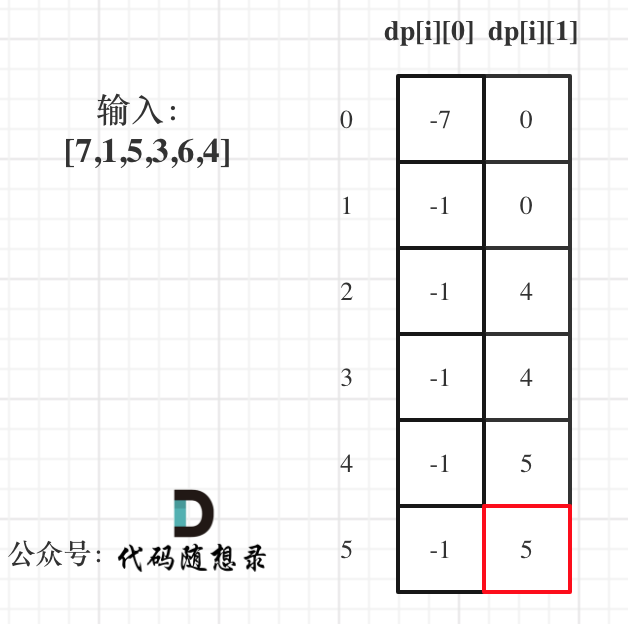
以示例1,输入:[7,1,5,3,6,4]为例,dp数组状态如下:
|
||
|
||
|
||
|
||
|
||
|
||
dp[5][1]就是最终结果。
|
||
|
||
为什么不是dp[5][0]呢?
|
||
|
||
**因为本题中不持有股票状态所得金钱一定比持有股票状态得到的多!**
|
||
|
||
以上分析完毕,C++代码如下:
|
||
|
||
```CPP
|
||
// 版本一
|
||
class Solution {
|
||
public:
|
||
int maxProfit(vector<int>& prices) {
|
||
int len = prices.size();
|
||
if (len == 0) return 0;
|
||
vector<vector<int>> dp(len, vector<int>(2));
|
||
dp[0][0] -= prices[0];
|
||
dp[0][1] = 0;
|
||
for (int i = 1; i < len; i++) {
|
||
dp[i][0] = max(dp[i - 1][0], -prices[i]);
|
||
dp[i][1] = max(dp[i - 1][1], prices[i] + dp[i - 1][0]);
|
||
}
|
||
return dp[len - 1][1];
|
||
}
|
||
};
|
||
```
|
||
|
||
* 时间复杂度:O(n)
|
||
* 空间复杂度:O(n)
|
||
|
||
从递推公式可以看出,dp[i]只是依赖于dp[i - 1]的状态。
|
||
|
||
```
|
||
dp[i][0] = max(dp[i - 1][0], -prices[i]);
|
||
dp[i][1] = max(dp[i - 1][1], prices[i] + dp[i - 1][0]);
|
||
```
|
||
|
||
那么我们只需要记录 当前天的dp状态和前一天的dp状态就可以了,可以使用滚动数组来节省空间,代码如下:
|
||
|
||
```CPP
|
||
// 版本二
|
||
class Solution {
|
||
public:
|
||
int maxProfit(vector<int>& prices) {
|
||
int len = prices.size();
|
||
vector<vector<int>> dp(2, vector<int>(2)); // 注意这里只开辟了一个2 * 2大小的二维数组
|
||
dp[0][0] -= prices[0];
|
||
dp[0][1] = 0;
|
||
for (int i = 1; i < len; i++) {
|
||
dp[i % 2][0] = max(dp[(i - 1) % 2][0], -prices[i]);
|
||
dp[i % 2][1] = max(dp[(i - 1) % 2][1], prices[i] + dp[(i - 1) % 2][0]);
|
||
}
|
||
return dp[(len - 1) % 2][1];
|
||
}
|
||
};
|
||
```
|
||
|
||
* 时间复杂度:O(n)
|
||
* 空间复杂度:O(1)
|
||
|
||
这里能写出版本一就可以了,版本二虽然原理都一样,但是想直接写出版本二还是有点麻烦,容易自己给自己找bug。
|
||
|
||
所以建议是先写出版本一,然后在版本一的基础上优化成版本二,而不是直接就写出版本二。
|
||
|
||
## 其他语言版本
|
||
|
||
### Java:
|
||
|
||
> 贪心法:
|
||
|
||
```java
|
||
class Solution {
|
||
public int maxProfit(int[] prices) {
|
||
// 找到一个最小的购入点
|
||
int low = Integer.MAX_VALUE;
|
||
// res不断更新,直到数组循环完毕
|
||
int res = 0;
|
||
for(int i = 0; i < prices.length; i++){
|
||
low = Math.min(prices[i], low);
|
||
res = Math.max(prices[i] - low, res);
|
||
}
|
||
return res;
|
||
}
|
||
}
|
||
```
|
||
> 动态规划:版本一
|
||
|
||
```java
|
||
// 解法1
|
||
class Solution {
|
||
public int maxProfit(int[] prices) {
|
||
if (prices == null || prices.length == 0) return 0;
|
||
int length = prices.length;
|
||
// dp[i][0]代表第i天持有股票的最大收益
|
||
// dp[i][1]代表第i天不持有股票的最大收益
|
||
int[][] dp = new int[length][2];
|
||
int result = 0;
|
||
dp[0][0] = -prices[0];
|
||
dp[0][1] = 0;
|
||
for (int i = 1; i < length; i++) {
|
||
dp[i][0] = Math.max(dp[i - 1][0], -prices[i]);
|
||
dp[i][1] = Math.max(dp[i - 1][0] + prices[i], dp[i - 1][1]);
|
||
}
|
||
return dp[length - 1][1];
|
||
}
|
||
}
|
||
```
|
||
> 动态规划:版本二(使用二維數組(和卡哥思路一致),下面還有使用一維滾動數組的更優化版本)
|
||
|
||
```Java
|
||
class Solution {
|
||
public int maxProfit(int[] prices) {
|
||
int len = prices.length;
|
||
int dp[][] = new int[2][2];
|
||
|
||
dp[0][0] = - prices[0];
|
||
dp[0][1] = 0;
|
||
|
||
for (int i = 1; i < len; i++){
|
||
dp[i % 2][0] = Math.max(dp[(i - 1) % 2][0], - prices[i]);
|
||
dp[i % 2][1] = Math.max(dp[(i - 1) % 2][1], prices[i] + dp[(i - 1) % 2][0]);
|
||
}
|
||
return dp[(len - 1) % 2][1];
|
||
}
|
||
}
|
||
```
|
||
|
||
> 动态规划:版本二(使用一維數組)
|
||
|
||
``` java
|
||
class Solution {
|
||
public int maxProfit(int[] prices) {
|
||
int[] dp = new int[2];
|
||
// 记录一次交易,一次交易有买入卖出两种状态
|
||
// 0代表持有,1代表卖出
|
||
dp[0] = -prices[0];
|
||
dp[1] = 0;
|
||
// 可以参考斐波那契问题的优化方式
|
||
// 我们从 i=1 开始遍历数组,一共有 prices.length 天,
|
||
// 所以是 i<=prices.length
|
||
for (int i = 1; i <= prices.length; i++) {
|
||
// 前一天持有;或当天买入
|
||
dp[0] = Math.max(dp[0], -prices[i - 1]);
|
||
// 如果 dp[0] 被更新,那么 dp[1] 肯定会被更新为正数的 dp[1]
|
||
// 而不是 dp[0]+prices[i-1]==0 的0,
|
||
// 所以这里使用会改变的dp[0]也是可以的
|
||
// 当然 dp[1] 初始值为 0 ,被更新成 0 也没影响
|
||
// 前一天卖出;或当天卖出, 当天要卖出,得前一天持有才行
|
||
dp[1] = Math.max(dp[1], dp[0] + prices[i - 1]);
|
||
}
|
||
return dp[1];
|
||
}
|
||
}
|
||
```
|
||
|
||
### Python:
|
||
|
||
> 贪心法:
|
||
```python
|
||
class Solution:
|
||
def maxProfit(self, prices: List[int]) -> int:
|
||
low = float("inf")
|
||
result = 0
|
||
for i in range(len(prices)):
|
||
low = min(low, prices[i]) #取最左最小价格
|
||
result = max(result, prices[i] - low) #直接取最大区间利润
|
||
return result
|
||
```
|
||
|
||
> 动态规划:版本一
|
||
```python
|
||
class Solution:
|
||
def maxProfit(self, prices: List[int]) -> int:
|
||
length = len(prices)
|
||
if length == 0:
|
||
return 0
|
||
dp = [[0] * 2 for _ in range(length)]
|
||
dp[0][0] = -prices[0]
|
||
dp[0][1] = 0
|
||
for i in range(1, length):
|
||
dp[i][0] = max(dp[i-1][0], -prices[i])
|
||
dp[i][1] = max(dp[i-1][1], prices[i] + dp[i-1][0])
|
||
return dp[-1][1]
|
||
```
|
||
|
||
> 动态规划:版本二
|
||
```python
|
||
class Solution:
|
||
def maxProfit(self, prices: List[int]) -> int:
|
||
length = len(prices)
|
||
dp = [[0] * 2 for _ in range(2)] #注意这里只开辟了一个2 * 2大小的二维数组
|
||
dp[0][0] = -prices[0]
|
||
dp[0][1] = 0
|
||
for i in range(1, length):
|
||
dp[i % 2][0] = max(dp[(i-1) % 2][0], -prices[i])
|
||
dp[i % 2][1] = max(dp[(i-1) % 2][1], prices[i] + dp[(i-1) % 2][0])
|
||
return dp[(length-1) % 2][1]
|
||
```
|
||
|
||
> 动态规划:版本三
|
||
```python
|
||
class Solution:
|
||
def maxProfit(self, prices: List[int]) -> int:
|
||
length = len(prices)
|
||
dp0, dp1 = -prices[0], 0 #注意这里只维护两个常量,因为dp0的更新不受dp1的影响
|
||
for i in range(1, length):
|
||
dp1 = max(dp1, dp0 + prices[i])
|
||
dp0 = max(dp0, -prices[i])
|
||
return dp1
|
||
```
|
||
|
||
### Go:
|
||
|
||
> 贪心法:
|
||
```Go
|
||
func maxProfit(prices []int) int {
|
||
min := prices[0]
|
||
res := 0
|
||
for i := 1; i < len(prices); i++ {
|
||
if prices[i] - min > res {
|
||
res = prices[i]-min
|
||
}
|
||
if min > prices[i] {
|
||
min = prices[i]
|
||
}
|
||
}
|
||
return res
|
||
}
|
||
```
|
||
|
||
> 动态规划:版本一
|
||
```Go
|
||
func maxProfit(prices []int) int {
|
||
length := len(prices)
|
||
if length == 0{return 0}
|
||
dp := make([][]int,length)
|
||
for i := 0; i < length; i++ {
|
||
dp[i] = make([]int, 2)
|
||
}
|
||
dp[0][0] = -prices[0]
|
||
dp[0][1] = 0
|
||
for i := 1; i < length; i++ {
|
||
dp[i][0] = max(dp[i-1][0], -prices[i])
|
||
dp[i][1] = max(dp[i-1][1], dp[i-1][0] + prices[i])
|
||
}
|
||
return dp[length-1][1]
|
||
}
|
||
|
||
func max(a, b int) int {
|
||
if a > b {
|
||
return a
|
||
}
|
||
return b
|
||
}
|
||
```
|
||
|
||
> 动态规划:版本二
|
||
```Go
|
||
func maxProfit(prices []int) int {
|
||
dp := [2][2]int{}
|
||
dp[0][0] = -prices[0]
|
||
dp[0][1] = 0
|
||
for i := 1; i < len(prices); i++ {
|
||
dp[i%2][0] = max(dp[(i-1)%2][0], -prices[i])
|
||
dp[i%2][1] = max(dp[(i-1)%2][1], dp[(i-1)%2][0]+prices[i])
|
||
}
|
||
|
||
return dp[(len(prices)-1)%2][1]
|
||
}
|
||
|
||
func max(a, b int) int {
|
||
if a > b{
|
||
return a
|
||
}
|
||
|
||
return b
|
||
}
|
||
```
|
||
|
||
### JavaScript:
|
||
|
||
> 动态规划
|
||
|
||
```javascript
|
||
const maxProfit = prices => {
|
||
const len = prices.length;
|
||
// 创建dp数组
|
||
const dp = new Array(len).fill([0, 0]);
|
||
// dp数组初始化
|
||
dp[0] = [-prices[0], 0];
|
||
for (let i = 1; i < len; i++) {
|
||
// 更新dp[i]
|
||
dp[i] = [
|
||
Math.max(dp[i - 1][0], -prices[i]),
|
||
Math.max(dp[i - 1][1], prices[i] + dp[i - 1][0]),
|
||
];
|
||
}
|
||
return dp[len - 1][1];
|
||
};
|
||
```
|
||
|
||
> 贪心法
|
||
|
||
```javascript
|
||
var maxProfit = function(prices) {
|
||
let lowerPrice = prices[0];// 重点是维护这个最小值(贪心的思想)
|
||
let profit = 0;
|
||
for(let i = 0; i < prices.length; i++){
|
||
lowerPrice = Math.min(lowerPrice, prices[i]);// 贪心地选择左面的最小价格
|
||
profit = Math.max(profit, prices[i] - lowerPrice);// 遍历一趟就可以获得最大利润
|
||
}
|
||
return profit;
|
||
};
|
||
```
|
||
|
||
### TypeScript:
|
||
|
||
> 贪心法
|
||
|
||
```typescript
|
||
function maxProfit(prices: number[]): number {
|
||
if (prices.length === 0) return 0;
|
||
let buy: number = prices[0];
|
||
let profitMax: number = 0;
|
||
for (let i = 1, length = prices.length; i < length; i++) {
|
||
profitMax = Math.max(profitMax, prices[i] - buy);
|
||
buy = Math.min(prices[i], buy);
|
||
}
|
||
return profitMax;
|
||
};
|
||
```
|
||
|
||
> 动态规划:版本一
|
||
|
||
```typescript
|
||
function maxProfit(prices: number[]): number {
|
||
/**
|
||
dp[i][0]: 第i天持有股票的最大现金
|
||
dp[i][1]: 第i天不持有股票的最大现金
|
||
*/
|
||
const length = prices.length;
|
||
if (length === 0) return 0;
|
||
const dp: number[][] = [];
|
||
dp[0] = [-prices[0], 0];
|
||
for (let i = 1; i < length; i++) {
|
||
dp[i] = [];
|
||
dp[i][0] = Math.max(dp[i - 1][0], -prices[i]);
|
||
dp[i][1] = Math.max(dp[i - 1][0] + prices[i], dp[i - 1][1]);
|
||
}
|
||
return dp[length - 1][1];
|
||
};
|
||
```
|
||
|
||
> 动态规划:版本二
|
||
|
||
```typescript
|
||
// dp[i][0] 表示第i天持有股票所得最多现金
|
||
// dp[i][1] 表示第i天不持有股票所得最多现金
|
||
function maxProfit(prices: number[]): number {
|
||
const dp:number[][] = Array(2).fill(0).map(item => Array(2));
|
||
dp[0][0] = -prices[0];
|
||
dp[0][1] = 0;
|
||
|
||
for (let i = 1; i < prices.length; i++) {
|
||
dp[i % 2][0] = Math.max(dp[(i - 1) % 2][0], -prices[i]);
|
||
dp[i % 2][1] = Math.max(dp[(i - 1) % 2][1], dp[(i - 1) % 2][0] + prices[i]);
|
||
}
|
||
|
||
// 返回不持有股票的最大现金
|
||
return dp[(prices.length-1) % 2][1];
|
||
};
|
||
```
|
||
|
||
### C#:
|
||
|
||
> 贪心法
|
||
|
||
```csharp
|
||
public class Solution
|
||
{
|
||
public int MaxProfit(int[] prices)
|
||
{
|
||
int min = Int32.MaxValue;
|
||
int res = 0;
|
||
for (int i = 0; i < prices.Length; i++)
|
||
{
|
||
min = Math.Min(prices[i], min);
|
||
res = Math.Max(prices[i] - min, res);
|
||
}
|
||
return res;
|
||
}
|
||
}
|
||
```
|
||
|
||
> 动态规划
|
||
|
||
```csharp
|
||
public class Solution
|
||
{
|
||
public int MaxProfit(int[] prices)
|
||
{
|
||
int[] dp = new int[2];
|
||
int size = prices.Length;
|
||
(dp[0], dp[1]) = (-prices[0], 0);
|
||
for (int i = 0; i < size; i++)
|
||
{
|
||
dp[0] = Math.Max(dp[0], -prices[i]);
|
||
dp[1] = Math.Max(dp[1], dp[0]+prices[i]);
|
||
}
|
||
return dp[1];
|
||
}
|
||
}
|
||
```
|
||
|
||
### C:
|
||
|
||
> 贪心
|
||
|
||
```c
|
||
#define max(a, b) ((a) > (b) ? (a) : (b))
|
||
#define min(a, b) ((a) > (b) ? (b) : (a))
|
||
|
||
int maxProfit(int* prices, int pricesSize) {
|
||
int low = INT_MIN;
|
||
int result = 0;
|
||
for(int i = 0; i < pricesSize; i++){
|
||
low = min(low, prices[i]);
|
||
result = max(result, prices[i] - low);
|
||
}
|
||
return result;
|
||
}
|
||
```
|
||
|
||
> 动态规划
|
||
|
||
```c
|
||
#define max(a, b) ((a) > (b) ? (a) : (b))
|
||
|
||
int maxProfit(int* prices, int pricesSize){
|
||
if(pricesSize == 0){
|
||
return 0;
|
||
}
|
||
// dp初始化
|
||
int ** dp = malloc(sizeof (int *) * pricesSize);
|
||
for(int i = 0; i < pricesSize; i++){
|
||
dp[i] = malloc(sizeof (int ) * 2);
|
||
}
|
||
// 下标0表示持有股票的情况下的最大现金,下标1表示不持有股票的情况下获得的最大现金
|
||
dp[0][0] = -prices[0];
|
||
dp[0][1] = 0;
|
||
for(int i = 1; i < pricesSize; i++){
|
||
dp[i][0] = max(dp[i - 1][0], - prices[i]);
|
||
dp[i][1] = max(dp[i - 1][1], dp[i - 1][0] + prices[i]);
|
||
}
|
||
return dp[pricesSize - 1][1];
|
||
}
|
||
```
|
||
|
||
|
||
|
||
### Rust:
|
||
|
||
> 贪心
|
||
|
||
```rust
|
||
impl Solution {
|
||
pub fn max_profit(prices: Vec<i32>) -> i32 {
|
||
let (mut low, mut res) = (i32::MAX, 0);
|
||
for p in prices {
|
||
low = p.min(low);
|
||
res = res.max(p - low);
|
||
}
|
||
res
|
||
}
|
||
}
|
||
```
|
||
|
||
> 动态规划
|
||
|
||
```rust
|
||
impl Solution {
|
||
pub fn max_profit(prices: Vec<i32>) -> i32 {
|
||
let mut dp = vec![-prices[0], 0];
|
||
for p in prices {
|
||
dp[0] = dp[0].max(-p);
|
||
dp[1] = dp[1].max(dp[0] + p);
|
||
}
|
||
dp[1]
|
||
}
|
||
}
|
||
```
|
||
|
||
|