mirror of
https://github.com/Light-City/CPlusPlusThings.git
synced 2026-10-28 19:04:45 +08:00
 dfe1c933b3
- const README: rewrite the space-saving claim per issue #5 follow-ups
  (constant-expression const vs #define immediates; which const qualify
  as constant expressions)
- const README: fix the class-section diagnosis per issue #338 (overload
  resolution picks the const overload; the restriction only surfaces
  once that overload is removed)
- sizeof README: virtual-inheritance result is compiler-dependent
  (GCC merges vbptr+vfptr -> 16, MSVC keeps them separate -> 32) #246
- static README: new section on internal linkage / access restriction
  with anonymous-namespace comparison #142
- 10-day practice: full problem list table + fixed day links #136
- new design_pattern/singleton/singleton_default.hpp: reusable
  thread-safe CRTP singleton template, compile+concurrency tested #303
147 lines
4.6 KiB
Markdown
147 lines
4.6 KiB
Markdown
> 本文档由 [C++那些事网站](https://light-city.github.io/stories_things/stl-source-analysis/array/) 同步生成,网站版本含多语言与更新排版。
|
||
|
||
# STL array 源码剖析
|
||
|
||
## 0.导语
|
||
|
||
源码剖析版本为gcc4.9.1。
|
||
|
||
C++ tr1全称Technical Report 1,是针对C++标准库的第一次扩展。C++标准c++0x会包括它,以及一些语言本身的扩充。tr1包括大家期待已久的smart pointer,正则表达式以及其他一些支持范型编程的内容。草案阶段,新增的类和模板的名字空间是std::tr1。
|
||
|
||
## 1.std::tr1::array
|
||
|
||
使用:
|
||
```
|
||
#include <tr1/array>
|
||
std::tr1::array<int ,10> a;
|
||
```
|
||
|
||
tr1中的array比较简单,模拟语言本身的数组,并且让其支持迭代器操作,使其同其他容器一样,能够调用算法。对于tr1中array没有构造与析构。迭代器是直接使用传递进来的类型定义指针。
|
||
|
||
简单的看一下这个静态数组array源码:
|
||
|
||
```cpp
|
||
template<typename _Tp, std::size_t _Nm>
|
||
struct array
|
||
{
|
||
typedef _Tp value_type;
|
||
typedef value_type& reference;
|
||
typedef const value_type& const_reference;
|
||
typedef value_type* iterator;
|
||
typedef const value_type* const_iterator;
|
||
typedef std::size_t size_type;
|
||
typedef std::ptrdiff_t difference_type;
|
||
typedef std::reverse_iterator<iterator> reverse_iterator;
|
||
typedef std::reverse_iterator<const_iterator> const_reverse_iterator;
|
||
}
|
||
```
|
||
里面使用`reverse_iterator`作为rbegin与rend操作的迭代器。
|
||
看上去上面一个迭代器,实际上两个,还有一个iterator,这个直接使用传递进来的类型定义指针,作为迭代器。
|
||
|
||
可以将其对比为vector中的正向与反向迭代器。
|
||
|
||
值得注意的是,在tr1::array中,支持传递数组大小为0,例如我们使用如下:
|
||
|
||
```
|
||
std::tr1::array<int,0> a;
|
||
```
|
||
对于这样的写法,会对应到下面:
|
||
```
|
||
// Support for zero-sized arrays mandatory.
|
||
value_type _M_instance[_Nm ? _Nm : 1];
|
||
```
|
||
根据传递进来的大小,如果不为0,就是传递进来的大小,否则为1。
|
||
|
||
|
||
## 2.std::array
|
||
|
||
使用
|
||
```
|
||
std::array<int ,10> a;
|
||
```
|
||
|
||
std中的array包含了
|
||
|
||
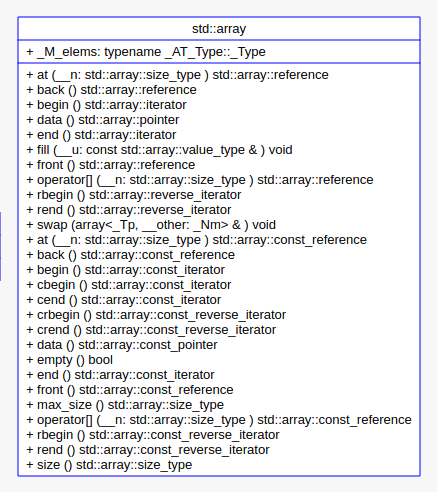
|
||
|
||
对比tr1与std的array
|
||
|
||
```cpp
|
||
template<typename _Tp, std::size_t _Nm>
|
||
struct array
|
||
{
|
||
typedef _Tp value_type;
|
||
typedef value_type* pointer;
|
||
typedef const value_type* const_pointer;
|
||
typedef value_type& reference;
|
||
typedef const value_type& const_reference;
|
||
typedef value_type* iterator;
|
||
typedef const value_type* const_iterator;
|
||
typedef std::size_t size_type;
|
||
typedef std::ptrdiff_t difference_type;
|
||
typedef std::reverse_iterator<iterator> reverse_iterator;
|
||
typedef std::reverse_iterator<const_iterator> const_reverse_iterator;
|
||
|
||
// Support for zero-sized arrays mandatory.
|
||
typedef _GLIBCXX_STD_C::__array_traits<_Tp, _Nm> _AT_Type; // # define _GLIBCXX_STD_C std
|
||
typename _AT_Type::_Type _M_elems;
|
||
}
|
||
```
|
||
|
||
发现array里面有两处值得注意的地方:
|
||
```cpp
|
||
// Support for zero-sized arrays mandatory.
|
||
typedef _GLIBCXX_STD_C::__array_traits<_Tp, _Nm> _AT_Type; // # define _GLIBCXX_STD_C std
|
||
typename _AT_Type::_Type _M_elems;
|
||
```
|
||
|
||
在源码中去找__array_traits,看到:
|
||
```cpp
|
||
template<typename _Tp, std::size_t _Nm>
|
||
struct __array_traits
|
||
{
|
||
typedef _Tp _Type[_Nm];
|
||
|
||
static constexpr _Tp&
|
||
_S_ref(const _Type& __t, std::size_t __n) noexcept
|
||
{ return const_cast<_Tp&>(__t[__n]); }
|
||
};
|
||
```
|
||
|
||
上面两行的代码可以理解为下面:
|
||
|
||
```cpp
|
||
typedef _Tp _Type[100];
|
||
typedef _Type _M_elems; // 一个含有100个元素的数组。
|
||
```
|
||
|
||
在实际写代码的时候,如果要定义一个数组,我们可以这样写:
|
||
```cpp
|
||
int a[100];
|
||
//或者
|
||
typedef int T[100];
|
||
typedef T a;
|
||
```
|
||
针对传进来的size处理,相比于tr1,更加复杂,使用了模板偏特化来处理传递size为0情况。
|
||
|
||
```cpp
|
||
template<typename _Tp, std::size_t _Nm>
|
||
struct __array_traits
|
||
{
|
||
typedef _Tp _Type[_Nm];
|
||
|
||
static constexpr _Tp&
|
||
_S_ref(const _Type& __t, std::size_t __n) noexcept
|
||
{ return const_cast<_Tp&>(__t[__n]); }
|
||
};
|
||
|
||
template<typename _Tp>
|
||
struct __array_traits<_Tp, 0>
|
||
{
|
||
struct _Type { };
|
||
|
||
static constexpr _Tp&
|
||
_S_ref(const _Type&, std::size_t) noexcept
|
||
{ return *static_cast<_Tp*>(nullptr); }
|
||
};
|
||
``` |